
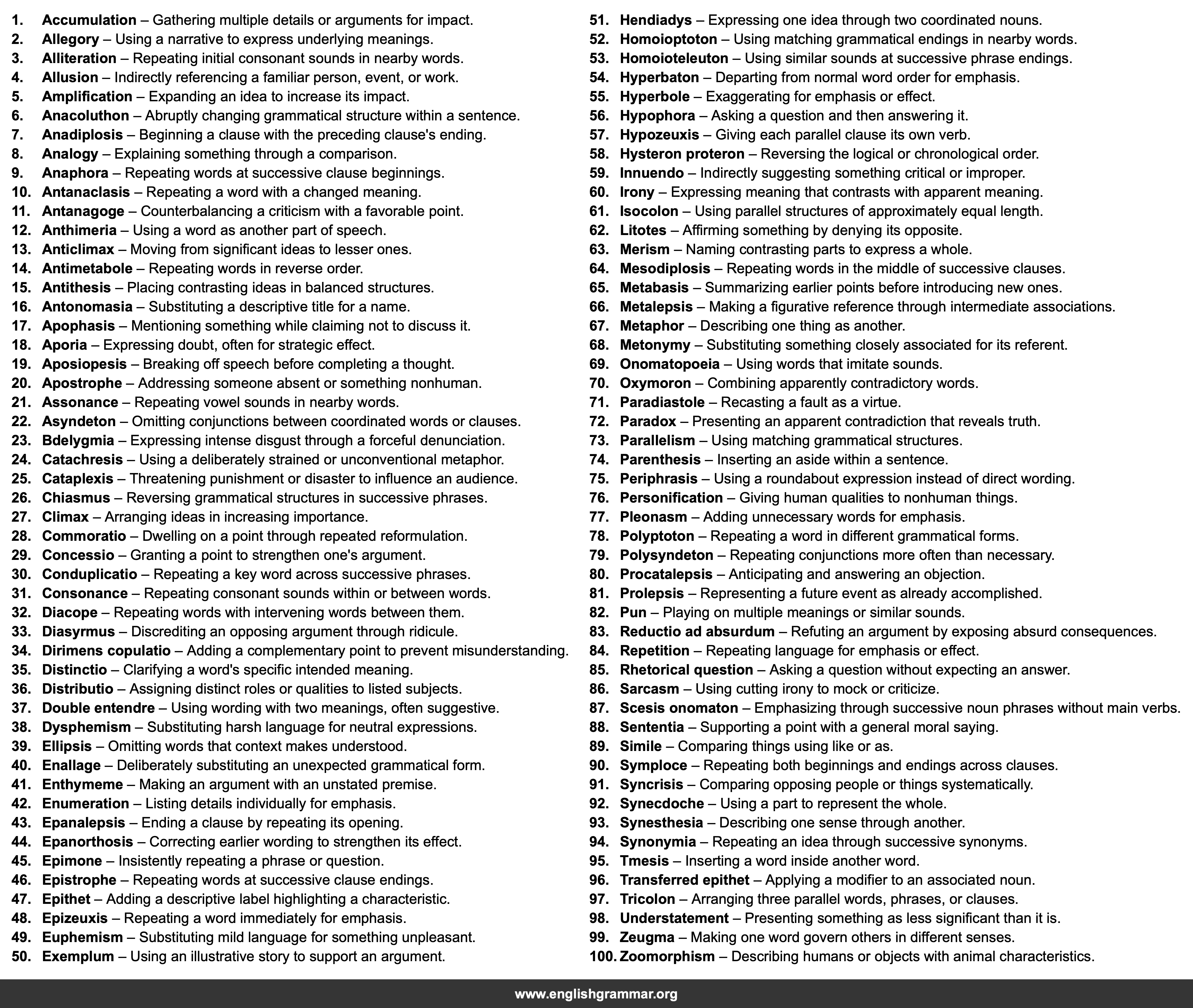
| No. | Item | Definition |
|---|---|---|
| 1. | Accumulation | Gathering multiple details or arguments for impact. |
| 2. | Allegory | Using a narrative to express underlying meanings. |
| 3. | Alliteration | Repeating initial consonant sounds in nearby words. |
| 4. | Allusion | Indirectly referencing a familiar person, event, or work. |
| 5. | Amplification | Expanding an idea to increase its impact. |
| 6. | Anacoluthon | Abruptly changing grammatical structure within a sentence. |
| 7. | Anadiplosis | Beginning a clause with the preceding clause’s ending. |
| 8. | Analogy | Explaining something through a comparison. |
| 9. | Anaphora | Repeating words at successive clause beginnings. |
| 10. | Antanaclasis | Repeating a word with a changed meaning. |
| 11. | Antanagoge | Counterbalancing a criticism with a favorable point. |
| 12. | Anthimeria | Using a word as another part of speech. |
| 13. | Anticlimax | Moving from significant ideas to lesser ones. |
| 14. | Antimetabole | Repeating words in reverse order. |
| 15. | Antithesis | Placing contrasting ideas in balanced structures. |
| 16. | Antonomasia | Substituting a descriptive title for a name. |
| 17. | Apophasis | Mentioning something while claiming not to discuss it. |
| 18. | Aporia | Expressing doubt, often for strategic effect. |
| 19. | Aposiopesis | Breaking off speech before completing a thought. |
| 20. | Apostrophe | Addressing someone absent or something nonhuman. |
| 21. | Assonance | Repeating vowel sounds in nearby words. |
| 22. | Asyndeton | Omitting conjunctions between coordinated words or clauses. |
| 23. | Bdelygmia | Expressing intense disgust through a forceful denunciation. |
| 24. | Catachresis | Using a deliberately strained or unconventional metaphor. |
| 25. | Cataplexis | Threatening punishment or disaster to influence an audience. |
| 26. | Chiasmus | Reversing grammatical structures in successive phrases. |
| 27. | Climax | Arranging ideas in increasing importance. |
| 28. | Commoratio | Dwelling on a point through repeated reformulation. |
| 29. | Concessio | Granting a point to strengthen one’s argument. |
| 30. | Conduplicatio | Repeating a key word across successive phrases. |
| 31. | Consonance | Repeating consonant sounds within or between words. |
| 32. | Diacope | Repeating words with intervening words between them. |
| 33. | Diasyrmus | Discrediting an opposing argument through ridicule. |
| 34. | Dirimens copulatio | Adding a complementary point to prevent misunderstanding. |
| 35. | Distinctio | Clarifying a word’s specific intended meaning. |
| 36. | Distributio | Assigning distinct roles or qualities to listed subjects. |
| 37. | Double entendre | Using wording with two meanings, often suggestive. |
| 38. | Dysphemism | Substituting harsh language for neutral expressions. |
| 39. | Ellipsis | Omitting words that context makes understood. |
| 40. | Enallage | Deliberately substituting an unexpected grammatical form. |
| 41. | Enthymeme | Making an argument with an unstated premise. |
| 42. | Enumeration | Listing details individually for emphasis. |
| 43. | Epanalepsis | Ending a clause by repeating its opening. |
| 44. | Epanorthosis | Correcting earlier wording to strengthen its effect. |
| 45. | Epimone | Insistently repeating a phrase or question. |
| 46. | Epistrophe | Repeating words at successive clause endings. |
| 47. | Epithet | Adding a descriptive label highlighting a characteristic. |
| 48. | Epizeuxis | Repeating a word immediately for emphasis. |
| 49. | Euphemism | Substituting mild language for something unpleasant. |
| 50. | Exemplum | Using an illustrative story to support an argument. |
| 51. | Hendiadys | Expressing one idea through two coordinated nouns. |
| 52. | Homoioptoton | Using matching grammatical endings in nearby words. |
| 53. | Homoioteleuton | Using similar sounds at successive phrase endings. |
| 54. | Hyperbaton | Departing from normal word order for emphasis. |
| 55. | Hyperbole | Exaggerating for emphasis or effect. |
| 56. | Hypophora | Asking a question and then answering it. |
| 57. | Hypozeuxis | Giving each parallel clause its own verb. |
| 58. | Hysteron proteron | Reversing the logical or chronological order. |
| 59. | Innuendo | Indirectly suggesting something critical or improper. |
| 60. | Irony | Expressing meaning that contrasts with apparent meaning. |
| 61. | Isocolon | Using parallel structures of approximately equal length. |
| 62. | Litotes | Affirming something by denying its opposite. |
| 63. | Merism | Naming contrasting parts to express a whole. |
| 64. | Mesodiplosis | Repeating words in the middle of successive clauses. |
| 65. | Metabasis | Summarizing earlier points before introducing new ones. |
| 66. | Metalepsis | Making a figurative reference through intermediate associations. |
| 67. | Metaphor | Describing one thing as another. |
| 68. | Metonymy | Substituting something closely associated for its referent. |
| 69. | Onomatopoeia | Using words that imitate sounds. |
| 70. | Oxymoron | Combining apparently contradictory words. |
| 71. | Paradiastole | Recasting a fault as a virtue. |
| 72. | Paradox | Presenting an apparent contradiction that reveals truth. |
| 73. | Parallelism | Using matching grammatical structures. |
| 74. | Parenthesis | Inserting an aside within a sentence. |
| 75. | Periphrasis | Using a roundabout expression instead of direct wording. |
| 76. | Personification | Giving human qualities to nonhuman things. |
| 77. | Pleonasm | Adding unnecessary words for emphasis. |
| 78. | Polyptoton | Repeating a word in different grammatical forms. |
| 79. | Polysyndeton | Repeating conjunctions more often than necessary. |
| 80. | Procatalepsis | Anticipating and answering an objection. |
| 81. | Prolepsis | Representing a future event as already accomplished. |
| 82. | Pun | Playing on multiple meanings or similar sounds. |
| 83. | Reductio ad absurdum | Refuting an argument by exposing absurd consequences. |
| 84. | Repetition | Repeating language for emphasis or effect. |
| 85. | Rhetorical question | Asking a question without expecting an answer. |
| 86. | Sarcasm | Using cutting irony to mock or criticize. |
| 87. | Scesis onomaton | Emphasizing through successive noun phrases without main verbs. |
| 88. | Sententia | Supporting a point with a general moral saying. |
| 89. | Simile | Comparing things using like or as. |
| 90. | Symploce | Repeating both beginnings and endings across clauses. |
| 91. | Syncrisis | Comparing opposing people or things systematically. |
| 92. | Synecdoche | Using a part to represent the whole. |
| 93. | Synesthesia | Describing one sense through another. |
| 94. | Synonymia | Repeating an idea through successive synonyms. |
| 95. | Tmesis | Inserting a word inside another word. |
| 96. | Transferred epithet | Applying a modifier to an associated noun. |
| 97. | Tricolon | Arranging three parallel words, phrases, or clauses. |
| 98. | Understatement | Presenting something as less significant than it is. |
| 99. | Zeugma | Making one word govern others in different senses. |
| 100. | Zoomorphism | Describing humans or objects with animal characteristics. |
