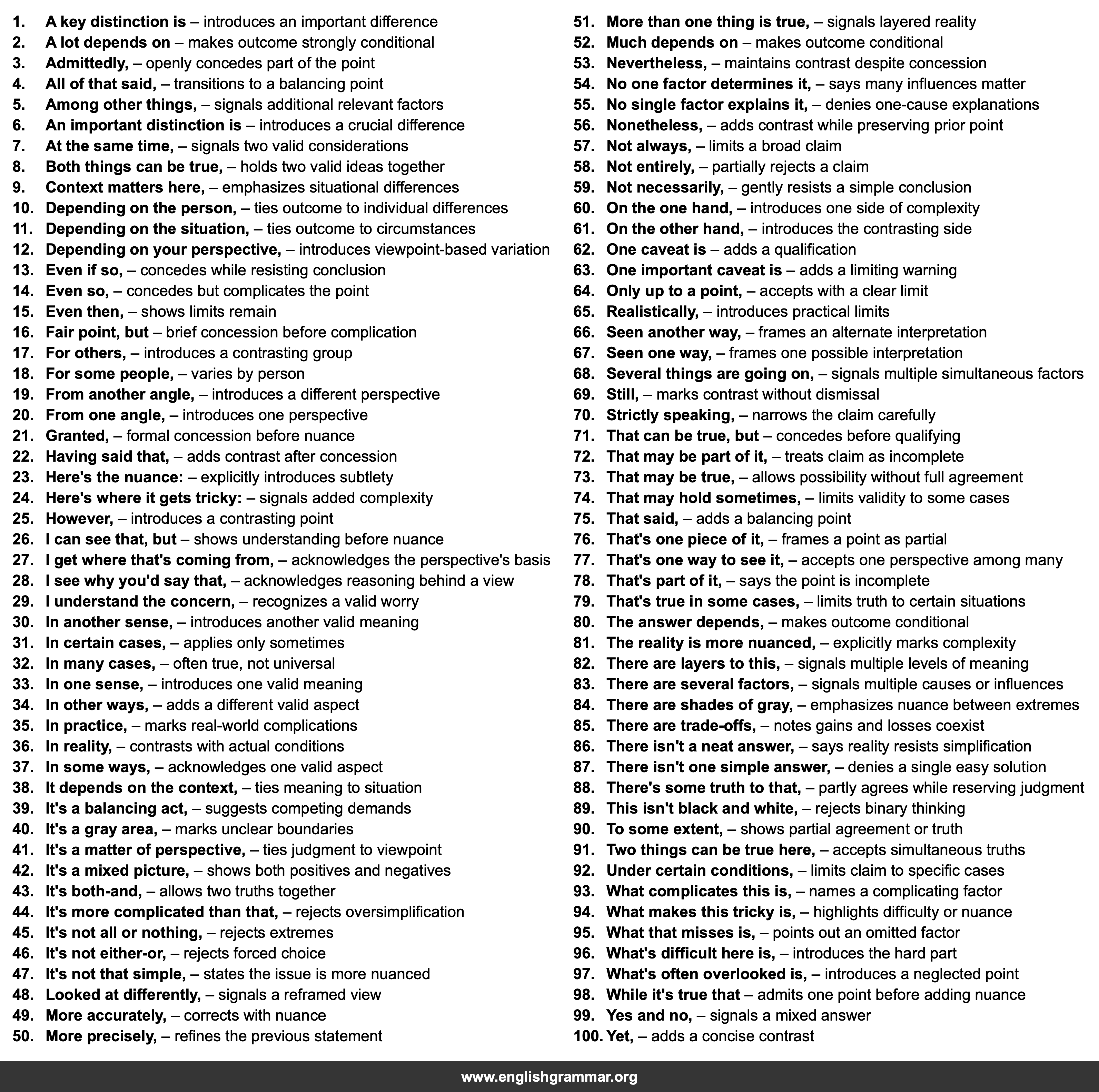
| No. | Item | Definition |
|---|---|---|
| 1. | A key distinction is | introduces an important difference |
| 2. | A lot depends on | makes outcome strongly conditional |
| 3. | Admittedly, | openly concedes part of the point |
| 4. | All of that said, | transitions to a balancing point |
| 5. | Among other things, | signals additional relevant factors |
| 6. | An important distinction is | introduces a crucial difference |
| 7. | At the same time, | signals two valid considerations |
| 8. | Both things can be true, | holds two valid ideas together |
| 9. | Context matters here, | emphasizes situational differences |
| 10. | Depending on the person, | ties outcome to individual differences |
| 11. | Depending on the situation, | ties outcome to circumstances |
| 12. | Depending on your perspective, | introduces viewpoint-based variation |
| 13. | Even if so, | concedes while resisting conclusion |
| 14. | Even so, | concedes but complicates the point |
| 15. | Even then, | shows limits remain |
| 16. | Fair point, but | brief concession before complication |
| 17. | For others, | introduces a contrasting group |
| 18. | For some people, | varies by person |
| 19. | From another angle, | introduces a different perspective |
| 20. | From one angle, | introduces one perspective |
| 21. | Granted, | formal concession before nuance |
| 22. | Having said that, | adds contrast after concession |
| 23. | Here’s the nuance: | explicitly introduces subtlety |
| 24. | Here’s where it gets tricky: | signals added complexity |
| 25. | However, | introduces a contrasting point |
| 26. | I can see that, but | shows understanding before nuance |
| 27. | I get where that’s coming from, | acknowledges the perspective’s basis |
| 28. | I see why you’d say that, | acknowledges reasoning behind a view |
| 29. | I understand the concern, | recognizes a valid worry |
| 30. | In another sense, | introduces another valid meaning |
| 31. | In certain cases, | applies only sometimes |
| 32. | In many cases, | often true, not universal |
| 33. | In one sense, | introduces one valid meaning |
| 34. | In other ways, | adds a different valid aspect |
| 35. | In practice, | marks real-world complications |
| 36. | In reality, | contrasts with actual conditions |
| 37. | In some ways, | acknowledges one valid aspect |
| 38. | It depends on the context, | ties meaning to situation |
| 39. | It’s a balancing act, | suggests competing demands |
| 40. | It’s a gray area, | marks unclear boundaries |
| 41. | It’s a matter of perspective, | ties judgment to viewpoint |
| 42. | It’s a mixed picture, | shows both positives and negatives |
| 43. | It’s both-and, | allows two truths together |
| 44. | It’s more complicated than that, | rejects oversimplification |
| 45. | It’s not all or nothing, | rejects extremes |
| 46. | It’s not either-or, | rejects forced choice |
| 47. | It’s not that simple, | states the issue is more nuanced |
| 48. | Looked at differently, | signals a reframed view |
| 49. | More accurately, | corrects with nuance |
| 50. | More precisely, | refines the previous statement |
| 51. | More than one thing is true, | signals layered reality |
| 52. | Much depends on | makes outcome conditional |
| 53. | Nevertheless, | maintains contrast despite concession |
| 54. | No one factor determines it, | says many influences matter |
| 55. | No single factor explains it, | denies one-cause explanations |
| 56. | Nonetheless, | adds contrast while preserving prior point |
| 57. | Not always, | limits a broad claim |
| 58. | Not entirely, | partially rejects a claim |
| 59. | Not necessarily, | gently resists a simple conclusion |
| 60. | On the one hand, | introduces one side of complexity |
| 61. | On the other hand, | introduces the contrasting side |
| 62. | One caveat is | adds a qualification |
| 63. | One important caveat is | adds a limiting warning |
| 64. | Only up to a point, | accepts with a clear limit |
| 65. | Realistically, | introduces practical limits |
| 66. | Seen another way, | frames an alternate interpretation |
| 67. | Seen one way, | frames one possible interpretation |
| 68. | Several things are going on, | signals multiple simultaneous factors |
| 69. | Still, | marks contrast without dismissal |
| 70. | Strictly speaking, | narrows the claim carefully |
| 71. | That can be true, but | concedes before qualifying |
| 72. | That may be part of it, | treats claim as incomplete |
| 73. | That may be true, | allows possibility without full agreement |
| 74. | That may hold sometimes, | limits validity to some cases |
| 75. | That said, | adds a balancing point |
| 76. | That’s one piece of it, | frames a point as partial |
| 77. | That’s one way to see it, | accepts one perspective among many |
| 78. | That’s part of it, | says the point is incomplete |
| 79. | That’s true in some cases, | limits truth to certain situations |
| 80. | The answer depends, | makes outcome conditional |
| 81. | The reality is more nuanced, | explicitly marks complexity |
| 82. | There are layers to this, | signals multiple levels of meaning |
| 83. | There are several factors, | signals multiple causes or influences |
| 84. | There are shades of gray, | emphasizes nuance between extremes |
| 85. | There are trade-offs, | notes gains and losses coexist |
| 86. | There isn’t a neat answer, | says reality resists simplification |
| 87. | There isn’t one simple answer, | denies a single easy solution |
| 88. | There’s some truth to that, | partly agrees while reserving judgment |
| 89. | This isn’t black and white, | rejects binary thinking |
| 90. | To some extent, | shows partial agreement or truth |
| 91. | Two things can be true here, | accepts simultaneous truths |
| 92. | Under certain conditions, | limits claim to specific cases |
| 93. | What complicates this is, | names a complicating factor |
| 94. | What makes this tricky is, | highlights difficulty or nuance |
| 95. | What that misses is, | points out an omitted factor |
| 96. | What’s difficult here is, | introduces the hard part |
| 97. | What’s often overlooked is, | introduces a neglected point |
| 98. | While it’s true that | admits one point before adding nuance |
| 99. | Yes and no, | signals a mixed answer |
| 100. | Yet, | adds a concise contrast |
