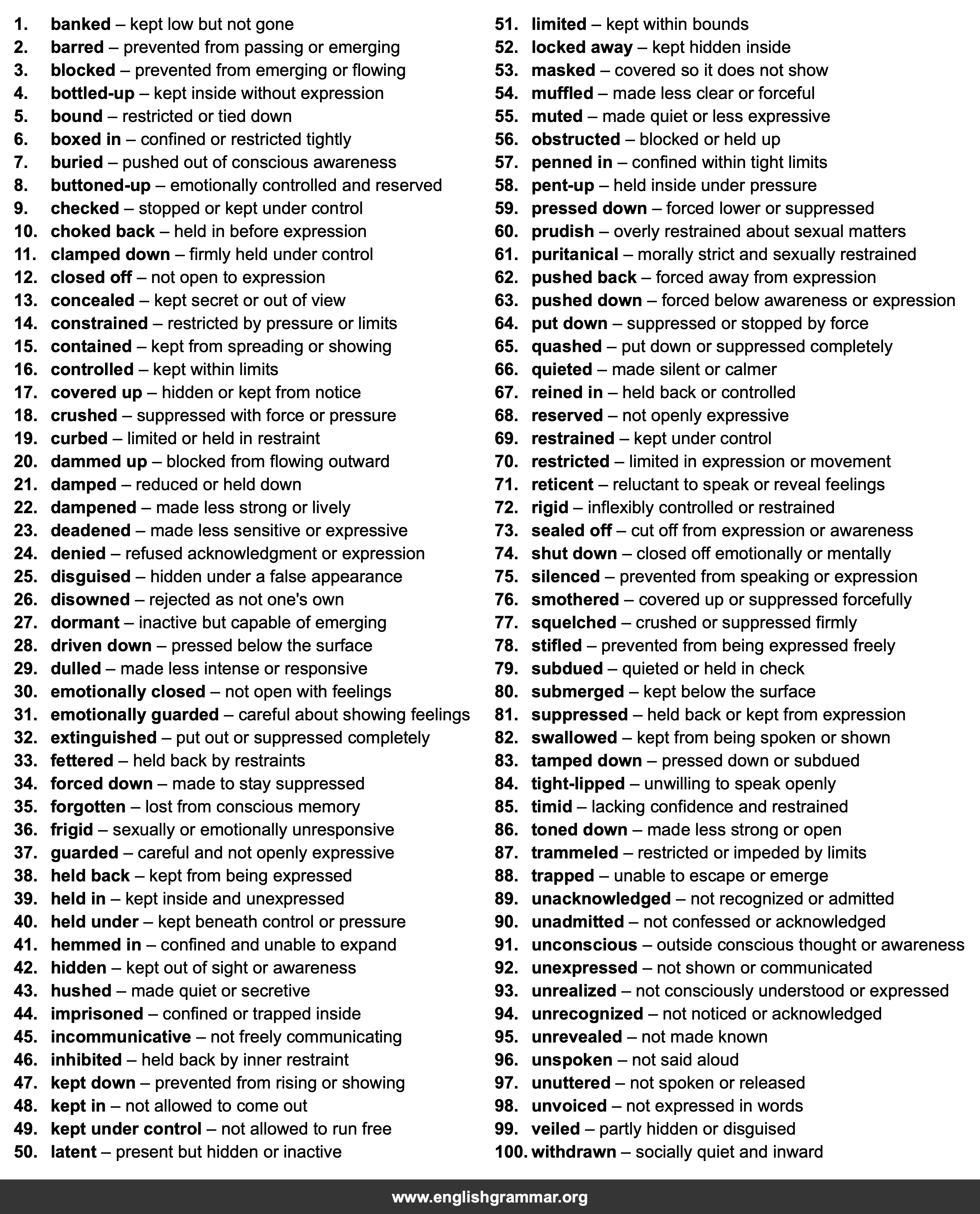
| No. | Item | Definition |
|---|---|---|
| 1. | banked | kept low but not gone |
| 2. | barred | prevented from passing or emerging |
| 3. | blocked | prevented from emerging or flowing |
| 4. | bottled-up | kept inside without expression |
| 5. | bound | restricted or tied down |
| 6. | boxed in | confined or restricted tightly |
| 7. | buried | pushed out of conscious awareness |
| 8. | buttoned-up | emotionally controlled and reserved |
| 9. | checked | stopped or kept under control |
| 10. | choked back | held in before expression |
| 11. | clamped down | firmly held under control |
| 12. | closed off | not open to expression |
| 13. | concealed | kept secret or out of view |
| 14. | constrained | restricted by pressure or limits |
| 15. | contained | kept from spreading or showing |
| 16. | controlled | kept within limits |
| 17. | covered up | hidden or kept from notice |
| 18. | crushed | suppressed with force or pressure |
| 19. | curbed | limited or held in restraint |
| 20. | dammed up | blocked from flowing outward |
| 21. | damped | reduced or held down |
| 22. | dampened | made less strong or lively |
| 23. | deadened | made less sensitive or expressive |
| 24. | denied | refused acknowledgment or expression |
| 25. | disguised | hidden under a false appearance |
| 26. | disowned | rejected as not one’s own |
| 27. | dormant | inactive but capable of emerging |
| 28. | driven down | pressed below the surface |
| 29. | dulled | made less intense or responsive |
| 30. | emotionally closed | not open with feelings |
| 31. | emotionally guarded | careful about showing feelings |
| 32. | extinguished | put out or suppressed completely |
| 33. | fettered | held back by restraints |
| 34. | forced down | made to stay suppressed |
| 35. | forgotten | lost from conscious memory |
| 36. | frigid | sexually or emotionally unresponsive |
| 37. | guarded | careful and not openly expressive |
| 38. | held back | kept from being expressed |
| 39. | held in | kept inside and unexpressed |
| 40. | held under | kept beneath control or pressure |
| 41. | hemmed in | confined and unable to expand |
| 42. | hidden | kept out of sight or awareness |
| 43. | hushed | made quiet or secretive |
| 44. | imprisoned | confined or trapped inside |
| 45. | incommunicative | not freely communicating |
| 46. | inhibited | held back by inner restraint |
| 47. | kept down | prevented from rising or showing |
| 48. | kept in | not allowed to come out |
| 49. | kept under control | not allowed to run free |
| 50. | latent | present but hidden or inactive |
| 51. | limited | kept within bounds |
| 52. | locked away | kept hidden inside |
| 53. | masked | covered so it does not show |
| 54. | muffled | made less clear or forceful |
| 55. | muted | made quiet or less expressive |
| 56. | obstructed | blocked or held up |
| 57. | penned in | confined within tight limits |
| 58. | pent-up | held inside under pressure |
| 59. | pressed down | forced lower or suppressed |
| 60. | prudish | overly restrained about sexual matters |
| 61. | puritanical | morally strict and sexually restrained |
| 62. | pushed back | forced away from expression |
| 63. | pushed down | forced below awareness or expression |
| 64. | put down | suppressed or stopped by force |
| 65. | quashed | put down or suppressed completely |
| 66. | quieted | made silent or calmer |
| 67. | reined in | held back or controlled |
| 68. | reserved | not openly expressive |
| 69. | restrained | kept under control |
| 70. | restricted | limited in expression or movement |
| 71. | reticent | reluctant to speak or reveal feelings |
| 72. | rigid | inflexibly controlled or restrained |
| 73. | sealed off | cut off from expression or awareness |
| 74. | shut down | closed off emotionally or mentally |
| 75. | silenced | prevented from speaking or expression |
| 76. | smothered | covered up or suppressed forcefully |
| 77. | squelched | crushed or suppressed firmly |
| 78. | stifled | prevented from being expressed freely |
| 79. | subdued | quieted or held in check |
| 80. | submerged | kept below the surface |
| 81. | suppressed | held back or kept from expression |
| 82. | swallowed | kept from being spoken or shown |
| 83. | tamped down | pressed down or subdued |
| 84. | tight-lipped | unwilling to speak openly |
| 85. | timid | lacking confidence and restrained |
| 86. | toned down | made less strong or open |
| 87. | trammeled | restricted or impeded by limits |
| 88. | trapped | unable to escape or emerge |
| 89. | unacknowledged | not recognized or admitted |
| 90. | unadmitted | not confessed or acknowledged |
| 91. | unconscious | outside conscious thought or awareness |
| 92. | unexpressed | not shown or communicated |
| 93. | unrealized | not consciously understood or expressed |
| 94. | unrecognized | not noticed or acknowledged |
| 95. | unrevealed | not made known |
| 96. | unspoken | not said aloud |
| 97. | unuttered | not spoken or released |
| 98. | unvoiced | not expressed in words |
| 99. | veiled | partly hidden or disguised |
| 100. | withdrawn | socially quiet and inward |
pinonly
100 Best Synonyms for “Ambiguity”
| No. | Item | Definition |
|---|---|---|
| 1. | amorphousness | lack of clear shape or meaning |
| 2. | blur | something unclear or indistinct |
| 3. | blurred meaning | meaning that is not sharp |
| 4. | blurred sense | sense lacking sharpness |
| 5. | blurred signification | unclear meaning |
| 6. | cloudiness | unclear or hazy quality |
| 7. | crypticness | quality of being hard to understand |
| 8. | double meaning | two possible meanings |
| 9. | double sense | two possible senses |
| 10. | elusiveness | hard-to-grasp quality |
| 11. | equivocal character | unclear or double nature |
| 12. | equivocal import | unclear significance |
| 13. | equivocal phrasing | phrasing with double meaning |
| 14. | equivocal sense | sense open to two meanings |
| 15. | equivocal tone | tone open to interpretations |
| 16. | equivocal wording | unclear wording with two meanings |
| 17. | equivocality | quality of having multiple meanings |
| 18. | equivocalness | quality of being open to meanings |
| 19. | equivocation | use of unclear double meaning |
| 20. | fog | state of unclear understanding |
| 21. | fuzziness | lack of sharp definition |
| 22. | fuzzy meaning | meaning without sharp edges |
| 23. | gray area | area lacking clear boundaries |
| 24. | grayness | lack of clear distinction |
| 25. | haze | state of unclear meaning |
| 26. | haziness | state of being vague |
| 27. | imprecision | lack of exactness |
| 28. | inconclusiveness | lack of definite conclusion |
| 29. | indefiniteness | lack of clear limits or meaning |
| 30. | indefinition | lack of clear definition |
| 31. | indeterminacy | state of being not fully determined |
| 32. | indeterminateness | lack of fixed determination |
| 33. | indistinction | lack of clear difference |
| 34. | indistinctness | lack of clear distinction |
| 35. | inexactitude | lack of exactness |
| 36. | inexactness | lack of exact meaning |
| 37. | inexplicitness | lack of full clarity |
| 38. | interpretive blur | blur in interpretation |
| 39. | interpretive doubt | doubt about interpretation |
| 40. | interpretive openness | openness to different readings |
| 41. | interpretive room | space for differing readings |
| 42. | interpretive uncertainty | uncertainty in interpretation |
| 43. | lack of clarity | absence of clear meaning |
| 44. | lack of definition | absence of clear definition |
| 45. | meaningfulness gap | gap in clear meaning |
| 46. | mistiness | hazy unclear quality |
| 47. | muddiness | confused or unclear quality |
| 48. | multivalence | having several possible meanings |
| 49. | murk | dark unclear state |
| 50. | murkiness | unclear or confusing quality |
| 51. | murky meaning | meaning that is unclear |
| 52. | murky phrasing | phrasing that is unclear |
| 53. | murky sense | sense that is unclear |
| 54. | mystification | confusing lack of clarity |
| 55. | nebulousness | vague and unclear quality |
| 56. | obliqueness | indirect or unclear quality |
| 57. | obliquity | indirect unclear expression |
| 58. | obscure meaning | meaning hard to understand |
| 59. | obscure phrasing | hard-to-understand wording |
| 60. | obscureness | quality of being obscure |
| 61. | obscurity | unclearness or hard-to-understand meaning |
| 62. | opacity | quality of being hard to understand |
| 63. | open-endedness | quality of not being fixed |
| 64. | polysemy | having multiple related meanings |
| 65. | puzzlement | state of uncertainty or confusion |
| 66. | questionableness | quality of being doubtful |
| 67. | semantic blur | blurred meaning |
| 68. | semantic confusion | confusion about meaning |
| 69. | semantic haze | hazy meaning |
| 70. | semantic indeterminacy | meaning not fully determined |
| 71. | semantic indirection | indirectness in meaning |
| 72. | semantic looseness | lack of precise meaning |
| 73. | semantic murk | murky meaning |
| 74. | semantic obscurity | obscurity in meaning |
| 75. | semantic opacity | hard-to-understand meaning |
| 76. | semantic openness | openness to multiple meanings |
| 77. | semantic slipperiness | meaning hard to pin down |
| 78. | semantic uncertainty | uncertainty in meaning |
| 79. | semantic vagueness | vagueness in meaning |
| 80. | slipperiness | hard-to-pin-down quality |
| 81. | uncertain phrasing | phrasing lacking clarity |
| 82. | uncertain purport | unclear intended meaning |
| 83. | uncertain reading | reading that is not settled |
| 84. | uncertain scope | scope that is not clear |
| 85. | uncertain sense | sense that is not clear |
| 86. | uncertain wording | wording open to interpretation |
| 87. | uncertainty | lack of clear certainty |
| 88. | unclear import | unclear significance or meaning |
| 89. | unclear meaning | meaning that is vague |
| 90. | unclear sense | sense lacking clarity |
| 91. | unclearness | state of not being clear |
| 92. | underdetermination | not fully fixed by evidence |
| 93. | vague formulation | imprecise way of stating |
| 94. | vague language | language lacking precision |
| 95. | vague phrasing | imprecise phrasing |
| 96. | vague sense | imprecise meaning |
| 97. | vague wording | imprecise wording |
| 98. | vagueness | lack of precise meaning |
| 99. | veiled meaning | meaning partly concealed |
| 100. | veiledness | quality of being partly hidden |
100 Best Synonyms for “Paradigmatic”
| No. | Item | Definition |
|---|---|---|
| 1. | accepted | generally approved or recognized |
| 2. | apparent | clearly visible or understood |
| 3. | archetypal | perfectly typical of its kind |
| 4. | authoritative | widely trusted as a standard |
| 5. | basic | forming the simplest standard |
| 6. | beacon | guiding example or signal |
| 7. | benchmark | serving as a point of reference |
| 8. | blueprint | detailed model for something |
| 9. | canonical | accepted as standard or model |
| 10. | case in point | clear supporting example |
| 11. | case study | detailed illustrative example |
| 12. | characteristic | typical of a person or thing |
| 13. | classic | widely recognized as standard |
| 14. | common | frequently found; typical |
| 15. | conventional | following accepted standard practice |
| 16. | customary | according to common practice |
| 17. | defining | giving essential character or identity |
| 18. | definitional | relating to essential meaning |
| 19. | definitive | serving as the clearest example |
| 20. | demonstrative | showing something clearly by example |
| 21. | determinative | decisive in shaping outcomes |
| 22. | distinctive | clearly marking a type |
| 23. | elucidative | helping explain something clearly |
| 24. | emblematic | symbolic of a typical quality |
| 25. | enlightening | giving clearer understanding |
| 26. | established | firmly accepted as standard |
| 27. | evident | clear and easily seen |
| 28. | exemplar | model example to follow |
| 29. | exemplary | illustrating a typical standard well |
| 30. | explicative | serving to explain meaning |
| 31. | formative | shaping basic character or pattern |
| 32. | foundational | forming the basic model |
| 33. | fundamental | forming an essential basis |
| 34. | gold standard | best accepted standard |
| 35. | hallmark | widely recognized as distinctive |
| 36. | highly typical | very representative of a kind |
| 37. | iconic | widely recognized as representative |
| 38. | ideal | representing a perfect standard |
| 39. | illuminating | making something easier to understand |
| 40. | illustrative | helpfully showing a general pattern |
| 41. | indicative | showing or suggesting a pattern |
| 42. | influential | having strong shaping power |
| 43. | informative | providing useful understanding |
| 44. | instance | single example of a type |
| 45. | instructive | useful as an example or lesson |
| 46. | key | crucially important or revealing |
| 47. | major | greater in importance or scale |
| 48. | manifest | clearly shown or obvious |
| 49. | marked | clearly noticeable or distinct |
| 50. | model | worthy of imitation or example |
| 51. | most typical | more representative than others |
| 52. | norm | usual or expected standard |
| 53. | normal | conforming to the usual pattern |
| 54. | normative | establishing or reflecting a norm |
| 55. | notable | worthy of attention as typical |
| 56. | object lesson | striking instructive example |
| 57. | obvious | easy to see or understand |
| 58. | organizing | giving order or structure |
| 59. | orthodox | conforming to accepted standards |
| 60. | overt | open and plainly shown |
| 61. | patent | obvious and unmistakable |
| 62. | pattern | model or repeated form |
| 63. | pivotal | centrally important to development |
| 64. | plain | clear and obvious |
| 65. | prominent | standing out clearly |
| 66. | pronounced | strongly noticeable or evident |
| 67. | prototype | original model of a type |
| 68. | prototypical | having the essential typical features |
| 69. | quintessential | most perfect example of something |
| 70. | recognized | generally acknowledged as standard |
| 71. | reference point | basis for comparison or judgment |
| 72. | regular | usual or customary in form |
| 73. | representative | serving as a standard example |
| 74. | revealing | making the pattern clear |
| 75. | rule | usual principle or standard |
| 76. | salient | most noticeable or important |
| 77. | sample | small example showing the whole |
| 78. | significant | important and revealing |
| 79. | standard | serving as an accepted norm |
| 80. | structural | relating to underlying form |
| 81. | symbolic | standing for a broader pattern |
| 82. | symptomatic | showing a characteristic condition |
| 83. | systemic | affecting the whole system |
| 84. | telling | revealing an important pattern |
| 85. | template | pattern used as a guide |
| 86. | textbook | perfectly typical in a standard way |
| 87. | typical | showing the usual pattern |
| 88. | unambiguous | clear and leaving no doubt |
| 89. | unmistakable | impossible to misinterpret |
| 90. | usual | happening in the normal way |
| 91. | visible | easy to notice or recognize |
| 92. | vivid | clear and striking in effect |
| 93. | vogue | current accepted style or pattern |
| 94. | well-established | firmly accepted over time |
| 95. | well-known | familiar to many people |
| 96. | widely accepted | recognized by most people |
| 97. | widely recognized | known and acknowledged broadly |
| 98. | workable | practical and effective in use |
| 99. | world-class | of the highest recognized standard |
| 100. | worthy | deserving respect or attention |
100 Best Synonyms for “Propaganda”
| No. | Item | Definition |
|---|---|---|
| 1. | active measures | covert influence and disinformation tactics |
| 2. | advertising | paid promotion of ideas or products |
| 3. | advocacy | public support for a cause |
| 4. | agitprop | political messaging with persuasive intent |
| 5. | appeals to emotion | emotion-based persuasive messaging |
| 6. | awareness campaign | public messaging to shape awareness |
| 7. | ballyhoo | noisy or sensational promotion |
| 8. | beating the drum | repeatedly urging support |
| 9. | belief marketing | promoting beliefs like products |
| 10. | belief-shaping | efforts to form beliefs |
| 11. | booster campaign | effort to build enthusiasm |
| 12. | boosterism | enthusiastic promotional advocacy |
| 13. | brainwashing | coercive persuasion that reshapes beliefs |
| 14. | broadcast persuasion | widely distributed persuasive messaging |
| 15. | campaigning | organized efforts to sway opinion |
| 16. | cause-promotion | publicity supporting a cause |
| 17. | character assassination | deliberate destruction of reputation |
| 18. | conditioning | training responses through repeated messaging |
| 19. | conversion effort | attempt to change beliefs |
| 20. | counterpropaganda | messaging used against opposing persuasion |
| 21. | creed-pushing | aggressive promotion of beliefs |
| 22. | cultivation | deliberate shaping of attitudes |
| 23. | deception | misleading others by false presentation |
| 24. | demagoguery | manipulative appeals to prejudice |
| 25. | demonization | portraying someone as evil |
| 26. | disinformation | false information spread deliberately |
| 27. | distortion | twisting facts to influence views |
| 28. | doctrinal teaching | instruction promoting fixed beliefs |
| 29. | drumbeating | persistent urging of support |
| 30. | drumming up support | actively generating public backing |
| 31. | emotional manipulation | using feelings to sway people |
| 32. | endorsement drive | campaign seeking public approval |
| 33. | evangelism | zealous promotion of an idea |
| 34. | fabrication | invented claims presented as true |
| 35. | falsification | deliberate alteration of the truth |
| 36. | fear appeal | persuasion based on fear |
| 37. | fearmongering | using fear to influence people |
| 38. | flag-waving | showy patriotic persuasion |
| 39. | framing | presenting facts to guide interpretation |
| 40. | hard sell | aggressive persuasive promotion |
| 41. | hype | intense publicity meant to excite |
| 42. | image management | controlling public impressions strategically |
| 43. | image-making | crafting favorable public impressions |
| 44. | inculcation | gradual instilling of beliefs |
| 45. | indoctrination | teaching meant to shape beliefs |
| 46. | influence campaign | organized effort to sway opinion |
| 47. | influence operations | planned efforts to shape opinion |
| 48. | information campaign | organized public messaging effort |
| 49. | information warfare | using information to gain advantage |
| 50. | loaded messaging | communication packed with bias |
| 51. | mass messaging | broad communication to shape opinion |
| 52. | mass persuasion | large-scale attempts to influence |
| 53. | media campaign | coordinated persuasive media effort |
| 54. | media spin | slanted interpretation for advantage |
| 55. | message control | tight management of public statements |
| 56. | messaging | crafted communication shaping public views |
| 57. | mind-shaping | influencing how people think |
| 58. | missionizing | active efforts to win converts |
| 59. | mobilization | rallying people to support action |
| 60. | mythmaking | creating persuasive public myths |
| 61. | narrative management | controlling how events are framed |
| 62. | narrative shaping | guiding the story people accept |
| 63. | news management | controlling news presentation strategically |
| 64. | opinion engineering | systematic shaping of public opinion |
| 65. | opinion molding | forming others’ views deliberately |
| 66. | opinion-shaping | efforts to mold public views |
| 67. | outreach | communication to engage and persuade |
| 68. | packaging | presenting something attractively or strategically |
| 69. | party line | official message to be repeated |
| 70. | perception management | shaping how people interpret events |
| 71. | persuasion | communication aimed at changing minds |
| 72. | pitch | persuasive presentation of an idea |
| 73. | plug | promotional mention or endorsement |
| 74. | promotion | publicity intended to win support |
| 75. | proselytizing | trying to convert others’ beliefs |
| 76. | public relations | managed communication shaping reputation |
| 77. | puffery | exaggerated praise in promotion |
| 78. | rabble-rousing | stirring crowds with inflammatory appeals |
| 79. | red-baiting | smearing as politically radical |
| 80. | salesmanship | persuasive promotion to gain acceptance |
| 81. | scaremongering | spreading fear for persuasive effect |
| 82. | scripted messaging | preplanned persuasive communication |
| 83. | sell | effort to make something accepted |
| 84. | slant | biased angle in presentation |
| 85. | sloganeering | using catchy slogans persuasively |
| 86. | smear campaign | organized attack on reputation |
| 87. | soft sell | subtle persuasive promotion |
| 88. | spin | biased presentation to influence opinion |
| 89. | state messaging | government-directed public communication |
| 90. | testimonial campaign | promotion using supportive statements |
| 91. | thought control | attempts to direct beliefs |
| 92. | viewpoint shaping | guiding others toward a viewpoint |
| 93. | vilification | harsh public denigration of someone |
| 94. | waving the flag | patriotic display to win support |
| 95. | whipping up sentiment | stirring emotions for support |
| 96. | whisper campaign | rumor-spreading to sway opinion |
| 97. | whitewashing | glossing over faults or wrongdoing |
| 98. | winning hearts and minds | gaining support through persuasion |
| 99. | word-spinning | manipulative phrasing to influence opinion |
| 100. | yellow journalism | sensationalized news shaping public opinion |
Inversion and Fronting Review Exercise
Complete the 12 sentences below. Choose the best answer for each one.
1Only after the audit ............... how serious the cash-flow problem had become.
Wrong!
After the negative adverbial 'Only after the audit', subject-auxiliary inversion is required, so the correct answer is "did the board realise".
2Rarely ............... such unanimous support from both unions and management.
Wrong!
A fronted negative-frequency adverb such as 'Rarely' requires inversion, so the correct answer is "has a proposal received".
3Under no circumstances ............... into the archive without written authorisation.
Wrong!
With the fronted negative phrase 'Under no circumstances', inversion is required, so the correct answer is "should visitors be allowed".
4Not until several hours after the meal ............... to appear.
Wrong!
When 'Not until' is fronted, the following main clause takes inversion, so the correct answer is "did the symptoms begin".
5So hostile ............... that the minister abandoned the press conference within minutes.
Wrong!
When 'so + adjective' is fronted for emphasis, the verb comes before the subject, so the correct answer is "was the response".
6Not a single risk ............... during the investor briefing.
Wrong!
A fronted negative object such as 'Not a single risk' requires inversion in the clause that follows, so the correct answer is "did she mention".
7Little ............... that the apparently minor delay would jeopardise the entire launch.
Wrong!
The fronted negative adverb 'Little' triggers inversion, so the correct answer is "did we suspect".
8Only if both parties sign the revised schedule ............... valid beyond June.
Wrong!
When an 'Only if' condition is fronted, the main clause takes inversion, so the correct answer is "will the contract remain".
9No sooner ............... than a fresh dispute over staffing levels emerged.
Wrong!
The fronted phrase 'No sooner' requires inversion with the auxiliary before the subject, so the correct answer is "had the negotiations resumed".
10At the far end of the table ..............., silent but visibly unconvinced.
Wrong!
After a fronted place expression in a formal descriptive style, the lexical verb can precede a full noun subject, so the correct answer is "stood the finance director".
11The budget cuts ..............., but the cancellation of the training programme is harder to justify.
Wrong!
When the object 'The budget cuts' is fronted, it should not be repeated by a pronoun in the same clause, so the correct answer is "I can defend".
12"We cannot accept those terms," ............... after a brief consultation with her team.
Wrong!
After fronted direct speech, formal narrative style often places the reporting verb before a full noun subject, so the correct answer is "said the chief negotiator".
Answers
- Only after the audit did the board realise how serious the cash-flow problem had become.
- Rarely has a proposal received such unanimous support from both unions and management.
- Under no circumstances should visitors be allowed into the archive without written authorisation.
- Not until several hours after the meal did the symptoms begin to appear.
- So hostile was the response that the minister abandoned the press conference within minutes.
- Not a single risk did she mention during the investor briefing.
- Little did we suspect that the apparently minor delay would jeopardise the entire launch.
- Only if both parties sign the revised schedule will the contract remain valid beyond June.
- No sooner had the negotiations resumed than a fresh dispute over staffing levels emerged.
- At the far end of the table stood the finance director, silent but visibly unconvinced.
- The budget cuts I can defend, but the cancellation of the training programme is harder to justify.
- “We cannot accept those terms,” said the chief negotiator after a brief consultation with her team.