
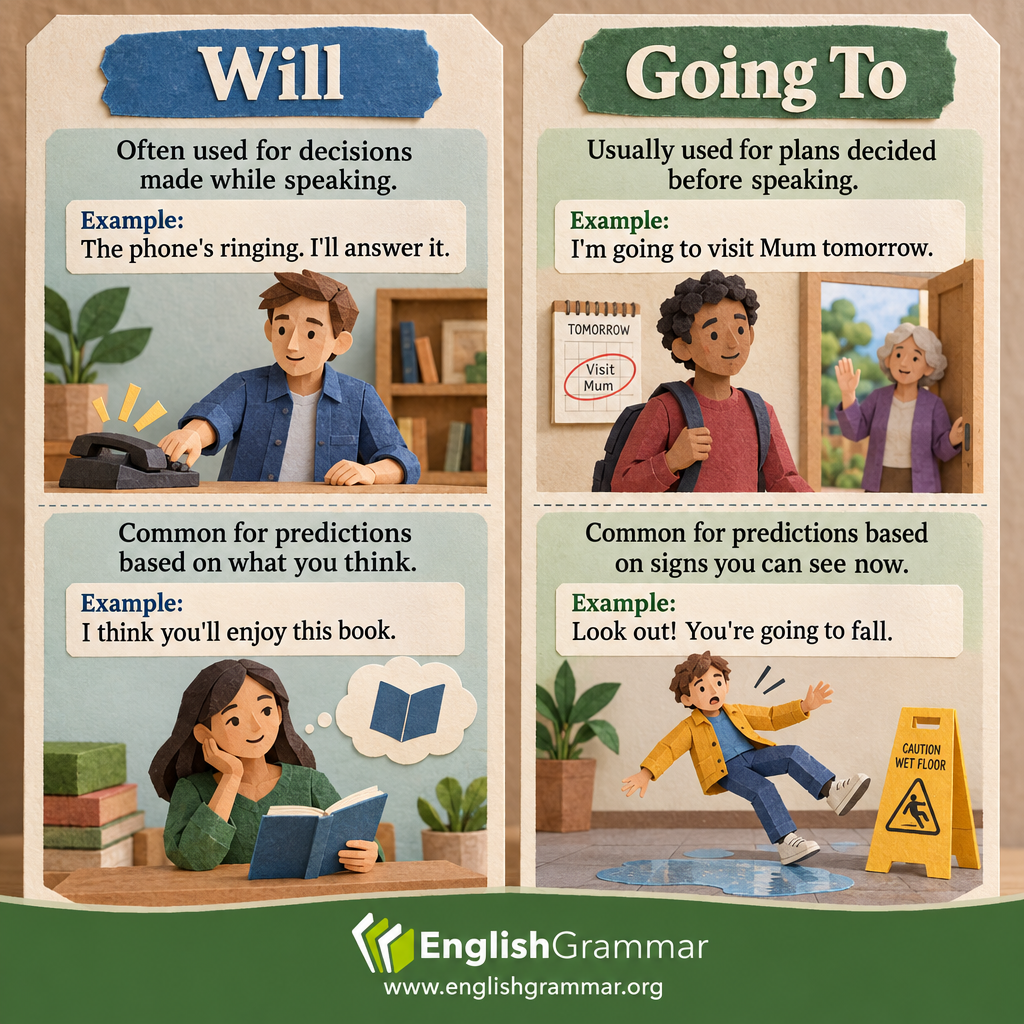
Will and going to both talk about the future. The choice often shows when you made a decision or what supports your prediction. These are useful patterns, not strict rules.
Decisions and plans
- Use will when you decide something while speaking: “We’re out of bread. I’ll buy some on my way home.” The speaker is making the decision now.
- Use going to for a plan you have already decided on: “I’m going to take a cooking class next month.” The plan exists before the speaker mentions it.
Predictions
- Will is common when a prediction expresses what you think or expect: “I think the journey will take about an hour.”
- Going to is common when something happening now supports the prediction: “That glass is wobbling. It’s going to fall.” The speaker can see a sign of what may happen next.
Remember the overlap. Both forms can make predictions, and sometimes either sounds natural. Choosing one can emphasize your expectation; choosing the other can emphasize current evidence. Neither form is limited to the near or distant future.
Build the forms correctly: use will + base verb, as in “She will arrive soon.” Use am/is/are + going to + base verb, as in “They are going to move next year.”
