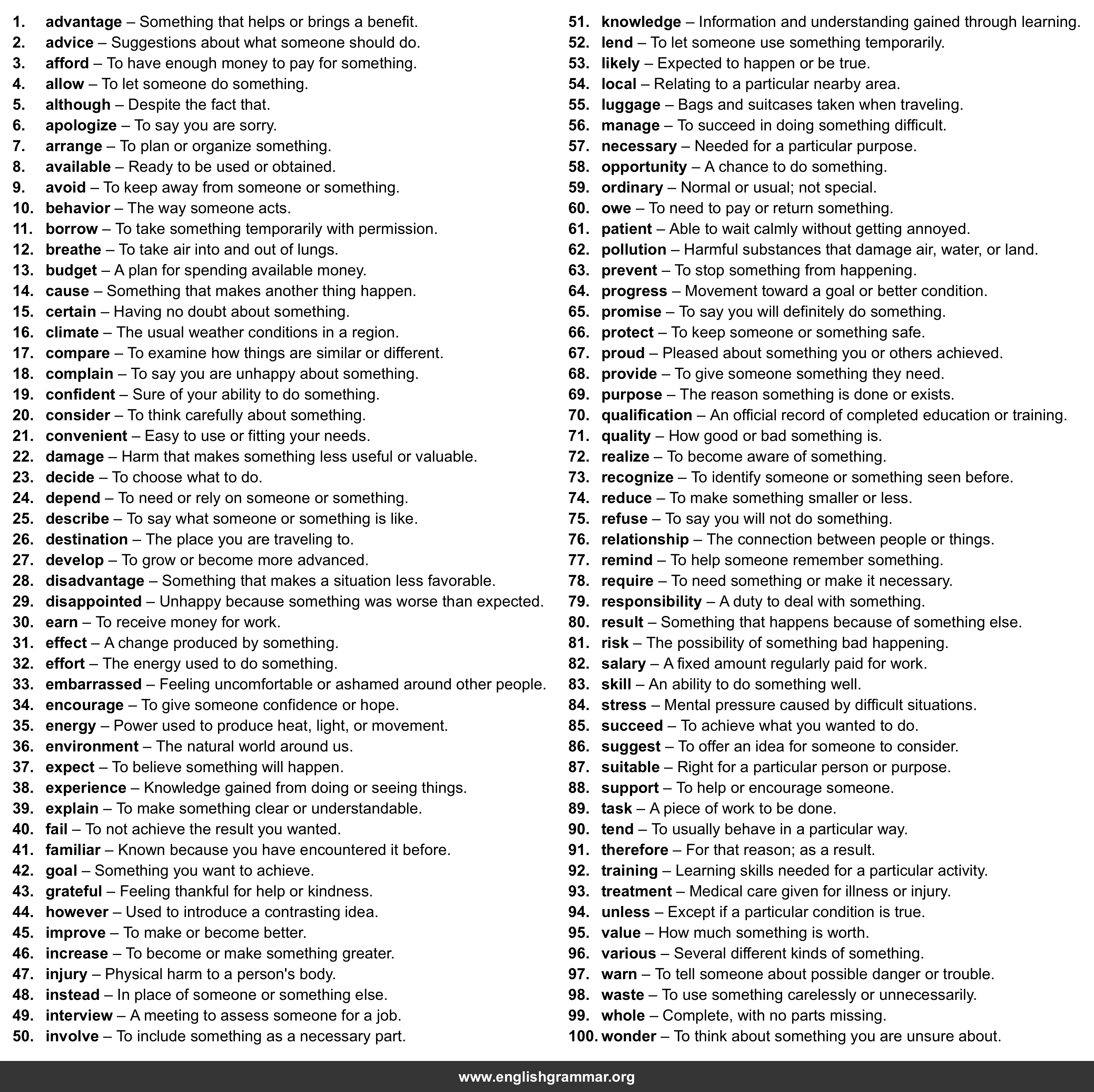
| No. | Item | Definition |
|---|---|---|
| 1. | advantage | Something that helps or brings a benefit. |
| 2. | advice | Suggestions about what someone should do. |
| 3. | afford | To have enough money to pay for something. |
| 4. | allow | To let someone do something. |
| 5. | although | Despite the fact that. |
| 6. | apologize | To say you are sorry. |
| 7. | arrange | To plan or organize something. |
| 8. | available | Ready to be used or obtained. |
| 9. | avoid | To keep away from someone or something. |
| 10. | behavior | The way someone acts. |
| 11. | borrow | To take something temporarily with permission. |
| 12. | breathe | To take air into and out of lungs. |
| 13. | budget | A plan for spending available money. |
| 14. | cause | Something that makes another thing happen. |
| 15. | certain | Having no doubt about something. |
| 16. | climate | The usual weather conditions in a region. |
| 17. | compare | To examine how things are similar or different. |
| 18. | complain | To say you are unhappy about something. |
| 19. | confident | Sure of your ability to do something. |
| 20. | consider | To think carefully about something. |
| 21. | convenient | Easy to use or fitting your needs. |
| 22. | damage | Harm that makes something less useful or valuable. |
| 23. | decide | To choose what to do. |
| 24. | depend | To need or rely on someone or something. |
| 25. | describe | To say what someone or something is like. |
| 26. | destination | The place you are traveling to. |
| 27. | develop | To grow or become more advanced. |
| 28. | disadvantage | Something that makes a situation less favorable. |
| 29. | disappointed | Unhappy because something was worse than expected. |
| 30. | earn | To receive money for work. |
| 31. | effect | A change produced by something. |
| 32. | effort | The energy used to do something. |
| 33. | embarrassed | Feeling uncomfortable or ashamed around other people. |
| 34. | encourage | To give someone confidence or hope. |
| 35. | energy | Power used to produce heat, light, or movement. |
| 36. | environment | The natural world around us. |
| 37. | expect | To believe something will happen. |
| 38. | experience | Knowledge gained from doing or seeing things. |
| 39. | explain | To make something clear or understandable. |
| 40. | fail | To not achieve the result you wanted. |
| 41. | familiar | Known because you have encountered it before. |
| 42. | goal | Something you want to achieve. |
| 43. | grateful | Feeling thankful for help or kindness. |
| 44. | however | Used to introduce a contrasting idea. |
| 45. | improve | To make or become better. |
| 46. | increase | To become or make something greater. |
| 47. | injury | Physical harm to a person’s body. |
| 48. | instead | In place of someone or something else. |
| 49. | interview | A meeting to assess someone for a job. |
| 50. | involve | To include something as a necessary part. |
| 51. | knowledge | Information and understanding gained through learning. |
| 52. | lend | To let someone use something temporarily. |
| 53. | likely | Expected to happen or be true. |
| 54. | local | Relating to a particular nearby area. |
| 55. | luggage | Bags and suitcases taken when traveling. |
| 56. | manage | To succeed in doing something difficult. |
| 57. | necessary | Needed for a particular purpose. |
| 58. | opportunity | A chance to do something. |
| 59. | ordinary | Normal or usual; not special. |
| 60. | owe | To need to pay or return something. |
| 61. | patient | Able to wait calmly without getting annoyed. |
| 62. | pollution | Harmful substances that damage air, water, or land. |
| 63. | prevent | To stop something from happening. |
| 64. | progress | Movement toward a goal or better condition. |
| 65. | promise | To say you will definitely do something. |
| 66. | protect | To keep someone or something safe. |
| 67. | proud | Pleased about something you or others achieved. |
| 68. | provide | To give someone something they need. |
| 69. | purpose | The reason something is done or exists. |
| 70. | qualification | An official record of completed education or training. |
| 71. | quality | How good or bad something is. |
| 72. | realize | To become aware of something. |
| 73. | recognize | To identify someone or something seen before. |
| 74. | reduce | To make something smaller or less. |
| 75. | refuse | To say you will not do something. |
| 76. | relationship | The connection between people or things. |
| 77. | remind | To help someone remember something. |
| 78. | require | To need something or make it necessary. |
| 79. | responsibility | A duty to deal with something. |
| 80. | result | Something that happens because of something else. |
| 81. | risk | The possibility of something bad happening. |
| 82. | salary | A fixed amount regularly paid for work. |
| 83. | skill | An ability to do something well. |
| 84. | stress | Mental pressure caused by difficult situations. |
| 85. | succeed | To achieve what you wanted to do. |
| 86. | suggest | To offer an idea for someone to consider. |
| 87. | suitable | Right for a particular person or purpose. |
| 88. | support | To help or encourage someone. |
| 89. | task | A piece of work to be done. |
| 90. | tend | To usually behave in a particular way. |
| 91. | therefore | For that reason; as a result. |
| 92. | training | Learning skills needed for a particular activity. |
| 93. | treatment | Medical care given for illness or injury. |
| 94. | unless | Except if a particular condition is true. |
| 95. | value | How much something is worth. |
| 96. | various | Several different kinds of something. |
| 97. | warn | To tell someone about possible danger or trouble. |
| 98. | waste | To use something carelessly or unnecessarily. |
| 99. | whole | Complete, with no parts missing. |
| 100. | wonder | To think about something you are unsure about. |
