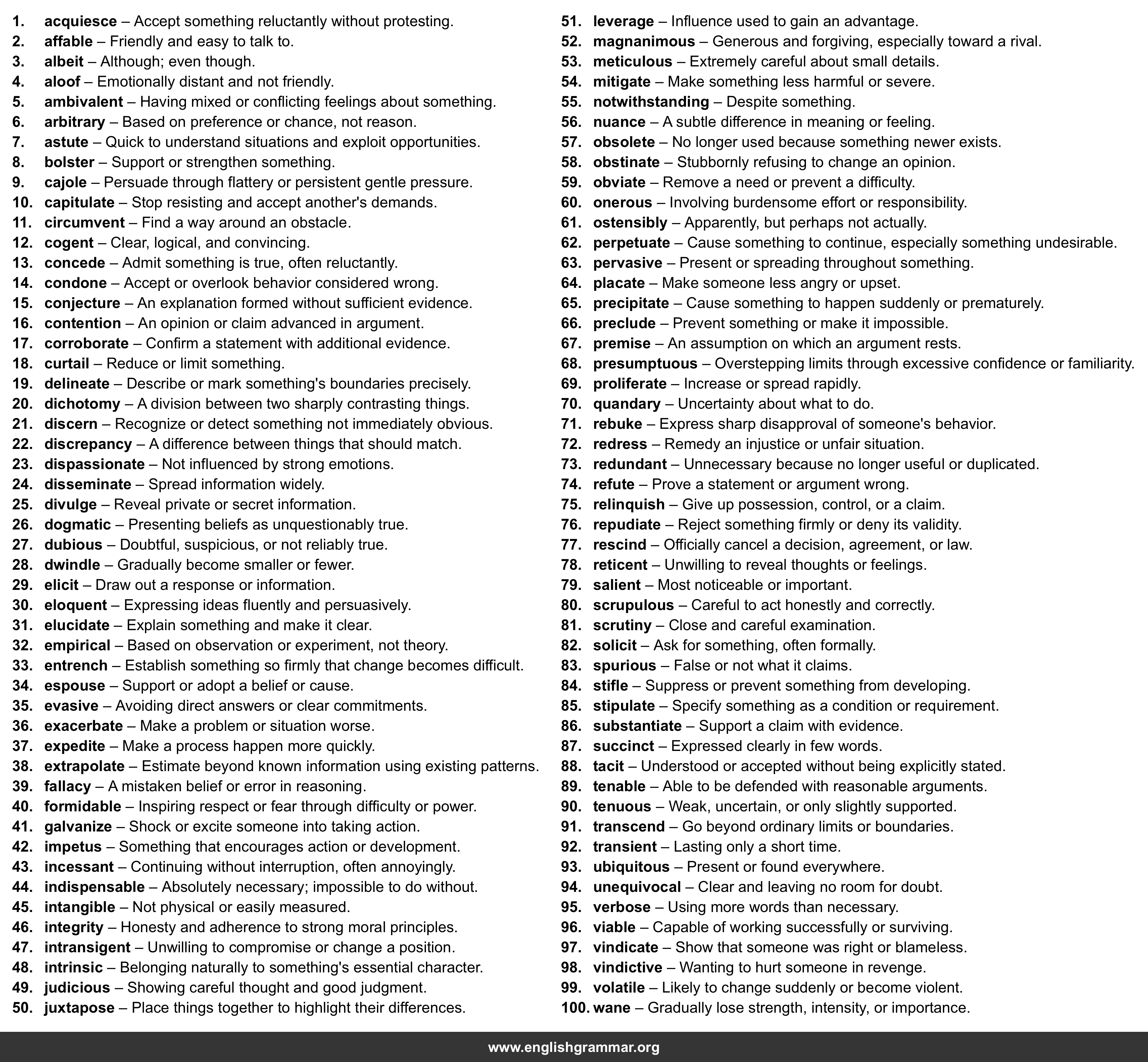
| No. | Item | Definition |
|---|---|---|
| 1. | acquiesce | Accept something reluctantly without protesting. |
| 2. | affable | Friendly and easy to talk to. |
| 3. | albeit | Although; even though. |
| 4. | aloof | Emotionally distant and not friendly. |
| 5. | ambivalent | Having mixed or conflicting feelings about something. |
| 6. | arbitrary | Based on preference or chance, not reason. |
| 7. | astute | Quick to understand situations and exploit opportunities. |
| 8. | bolster | Support or strengthen something. |
| 9. | cajole | Persuade through flattery or persistent gentle pressure. |
| 10. | capitulate | Stop resisting and accept another’s demands. |
| 11. | circumvent | Find a way around an obstacle. |
| 12. | cogent | Clear, logical, and convincing. |
| 13. | concede | Admit something is true, often reluctantly. |
| 14. | condone | Accept or overlook behavior considered wrong. |
| 15. | conjecture | An explanation formed without sufficient evidence. |
| 16. | contention | An opinion or claim advanced in argument. |
| 17. | corroborate | Confirm a statement with additional evidence. |
| 18. | curtail | Reduce or limit something. |
| 19. | delineate | Describe or mark something’s boundaries precisely. |
| 20. | dichotomy | A division between two sharply contrasting things. |
| 21. | discern | Recognize or detect something not immediately obvious. |
| 22. | discrepancy | A difference between things that should match. |
| 23. | dispassionate | Not influenced by strong emotions. |
| 24. | disseminate | Spread information widely. |
| 25. | divulge | Reveal private or secret information. |
| 26. | dogmatic | Presenting beliefs as unquestionably true. |
| 27. | dubious | Doubtful, suspicious, or not reliably true. |
| 28. | dwindle | Gradually become smaller or fewer. |
| 29. | elicit | Draw out a response or information. |
| 30. | eloquent | Expressing ideas fluently and persuasively. |
| 31. | elucidate | Explain something and make it clear. |
| 32. | empirical | Based on observation or experiment, not theory. |
| 33. | entrench | Establish something so firmly that change becomes difficult. |
| 34. | espouse | Support or adopt a belief or cause. |
| 35. | evasive | Avoiding direct answers or clear commitments. |
| 36. | exacerbate | Make a problem or situation worse. |
| 37. | expedite | Make a process happen more quickly. |
| 38. | extrapolate | Estimate beyond known information using existing patterns. |
| 39. | fallacy | A mistaken belief or error in reasoning. |
| 40. | formidable | Inspiring respect or fear through difficulty or power. |
| 41. | galvanize | Shock or excite someone into taking action. |
| 42. | impetus | Something that encourages action or development. |
| 43. | incessant | Continuing without interruption, often annoyingly. |
| 44. | indispensable | Absolutely necessary; impossible to do without. |
| 45. | intangible | Not physical or easily measured. |
| 46. | integrity | Honesty and adherence to strong moral principles. |
| 47. | intransigent | Unwilling to compromise or change a position. |
| 48. | intrinsic | Belonging naturally to something’s essential character. |
| 49. | judicious | Showing careful thought and good judgment. |
| 50. | juxtapose | Place things together to highlight their differences. |
| 51. | leverage | Influence used to gain an advantage. |
| 52. | magnanimous | Generous and forgiving, especially toward a rival. |
| 53. | meticulous | Extremely careful about small details. |
| 54. | mitigate | Make something less harmful or severe. |
| 55. | notwithstanding | Despite something. |
| 56. | nuance | A subtle difference in meaning or feeling. |
| 57. | obsolete | No longer used because something newer exists. |
| 58. | obstinate | Stubbornly refusing to change an opinion. |
| 59. | obviate | Remove a need or prevent a difficulty. |
| 60. | onerous | Involving burdensome effort or responsibility. |
| 61. | ostensibly | Apparently, but perhaps not actually. |
| 62. | perpetuate | Cause something to continue, especially something undesirable. |
| 63. | pervasive | Present or spreading throughout something. |
| 64. | placate | Make someone less angry or upset. |
| 65. | precipitate | Cause something to happen suddenly or prematurely. |
| 66. | preclude | Prevent something or make it impossible. |
| 67. | premise | An assumption on which an argument rests. |
| 68. | presumptuous | Overstepping limits through excessive confidence or familiarity. |
| 69. | proliferate | Increase or spread rapidly. |
| 70. | quandary | Uncertainty about what to do. |
| 71. | rebuke | Express sharp disapproval of someone’s behavior. |
| 72. | redress | Remedy an injustice or unfair situation. |
| 73. | redundant | Unnecessary because no longer useful or duplicated. |
| 74. | refute | Prove a statement or argument wrong. |
| 75. | relinquish | Give up possession, control, or a claim. |
| 76. | repudiate | Reject something firmly or deny its validity. |
| 77. | rescind | Officially cancel a decision, agreement, or law. |
| 78. | reticent | Unwilling to reveal thoughts or feelings. |
| 79. | salient | Most noticeable or important. |
| 80. | scrupulous | Careful to act honestly and correctly. |
| 81. | scrutiny | Close and careful examination. |
| 82. | solicit | Ask for something, often formally. |
| 83. | spurious | False or not what it claims. |
| 84. | stifle | Suppress or prevent something from developing. |
| 85. | stipulate | Specify something as a condition or requirement. |
| 86. | substantiate | Support a claim with evidence. |
| 87. | succinct | Expressed clearly in few words. |
| 88. | tacit | Understood or accepted without being explicitly stated. |
| 89. | tenable | Able to be defended with reasonable arguments. |
| 90. | tenuous | Weak, uncertain, or only slightly supported. |
| 91. | transcend | Go beyond ordinary limits or boundaries. |
| 92. | transient | Lasting only a short time. |
| 93. | ubiquitous | Present or found everywhere. |
| 94. | unequivocal | Clear and leaving no room for doubt. |
| 95. | verbose | Using more words than necessary. |
| 96. | viable | Capable of working successfully or surviving. |
| 97. | vindicate | Show that someone was right or blameless. |
| 98. | vindictive | Wanting to hurt someone in revenge. |
| 99. | volatile | Likely to change suddenly or become violent. |
| 100. | wane | Gradually lose strength, intensity, or importance. |
