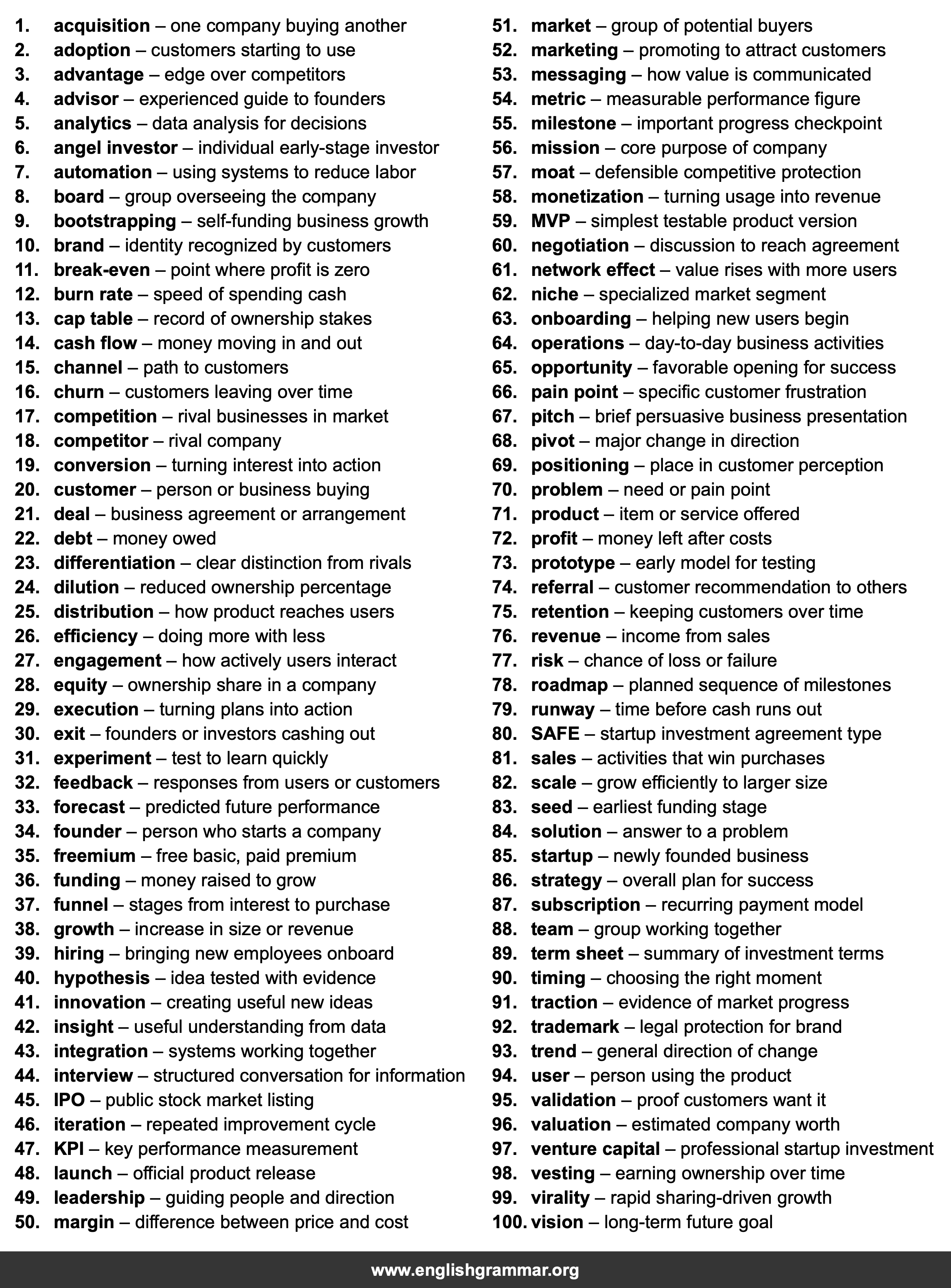
| No. | Item | Definition |
|---|---|---|
| 1. | acquisition | one company buying another |
| 2. | adoption | customers starting to use |
| 3. | advantage | edge over competitors |
| 4. | advisor | experienced guide to founders |
| 5. | analytics | data analysis for decisions |
| 6. | angel investor | individual early-stage investor |
| 7. | automation | using systems to reduce labor |
| 8. | board | group overseeing the company |
| 9. | bootstrapping | self-funding business growth |
| 10. | brand | identity recognized by customers |
| 11. | break-even | point where profit is zero |
| 12. | burn rate | speed of spending cash |
| 13. | cap table | record of ownership stakes |
| 14. | cash flow | money moving in and out |
| 15. | channel | path to customers |
| 16. | churn | customers leaving over time |
| 17. | competition | rival businesses in market |
| 18. | competitor | rival company |
| 19. | conversion | turning interest into action |
| 20. | customer | person or business buying |
| 21. | deal | business agreement or arrangement |
| 22. | debt | money owed |
| 23. | differentiation | clear distinction from rivals |
| 24. | dilution | reduced ownership percentage |
| 25. | distribution | how product reaches users |
| 26. | efficiency | doing more with less |
| 27. | engagement | how actively users interact |
| 28. | equity | ownership share in a company |
| 29. | execution | turning plans into action |
| 30. | exit | founders or investors cashing out |
| 31. | experiment | test to learn quickly |
| 32. | feedback | responses from users or customers |
| 33. | forecast | predicted future performance |
| 34. | founder | person who starts a company |
| 35. | freemium | free basic, paid premium |
| 36. | funding | money raised to grow |
| 37. | funnel | stages from interest to purchase |
| 38. | growth | increase in size or revenue |
| 39. | hiring | bringing new employees onboard |
| 40. | hypothesis | idea tested with evidence |
| 41. | innovation | creating useful new ideas |
| 42. | insight | useful understanding from data |
| 43. | integration | systems working together |
| 44. | interview | structured conversation for information |
| 45. | IPO | public stock market listing |
| 46. | iteration | repeated improvement cycle |
| 47. | KPI | key performance measurement |
| 48. | launch | official product release |
| 49. | leadership | guiding people and direction |
| 50. | margin | difference between price and cost |
| 51. | market | group of potential buyers |
| 52. | marketing | promoting to attract customers |
| 53. | messaging | how value is communicated |
| 54. | metric | measurable performance figure |
| 55. | milestone | important progress checkpoint |
| 56. | mission | core purpose of company |
| 57. | moat | defensible competitive protection |
| 58. | monetization | turning usage into revenue |
| 59. | MVP | simplest testable product version |
| 60. | negotiation | discussion to reach agreement |
| 61. | network effect | value rises with more users |
| 62. | niche | specialized market segment |
| 63. | onboarding | helping new users begin |
| 64. | operations | day-to-day business activities |
| 65. | opportunity | favorable opening for success |
| 66. | pain point | specific customer frustration |
| 67. | pitch | brief persuasive business presentation |
| 68. | pivot | major change in direction |
| 69. | positioning | place in customer perception |
| 70. | problem | need or pain point |
| 71. | product | item or service offered |
| 72. | profit | money left after costs |
| 73. | prototype | early model for testing |
| 74. | referral | customer recommendation to others |
| 75. | retention | keeping customers over time |
| 76. | revenue | income from sales |
| 77. | risk | chance of loss or failure |
| 78. | roadmap | planned sequence of milestones |
| 79. | runway | time before cash runs out |
| 80. | SAFE | startup investment agreement type |
| 81. | sales | activities that win purchases |
| 82. | scale | grow efficiently to larger size |
| 83. | seed | earliest funding stage |
| 84. | solution | answer to a problem |
| 85. | startup | newly founded business |
| 86. | strategy | overall plan for success |
| 87. | subscription | recurring payment model |
| 88. | team | group working together |
| 89. | term sheet | summary of investment terms |
| 90. | timing | choosing the right moment |
| 91. | traction | evidence of market progress |
| 92. | trademark | legal protection for brand |
| 93. | trend | general direction of change |
| 94. | user | person using the product |
| 95. | validation | proof customers want it |
| 96. | valuation | estimated company worth |
| 97. | venture capital | professional startup investment |
| 98. | vesting | earning ownership over time |
| 99. | virality | rapid sharing-driven growth |
| 100. | vision | long-term future goal |
