
• Skip to primary navigation
  • Skip to main content
  • Skip to primary sidebar
Home of English Grammar
  • Home
  • Course
  • Exercises
  • Grammar Rules
  • Vocabulary Matches
  • Posts
  • Tools
    • Grammar Checker
    • Very Replacer
    • Word Counter
  • Vocabulary Lists
  • Archives
    • Social Media Posts
    • Writing Guides
  • Sign in
  • Join free

Where “buy the farm” comes from, and why its origin is still debated

May 12, 2026

The origin of "buy the farm"

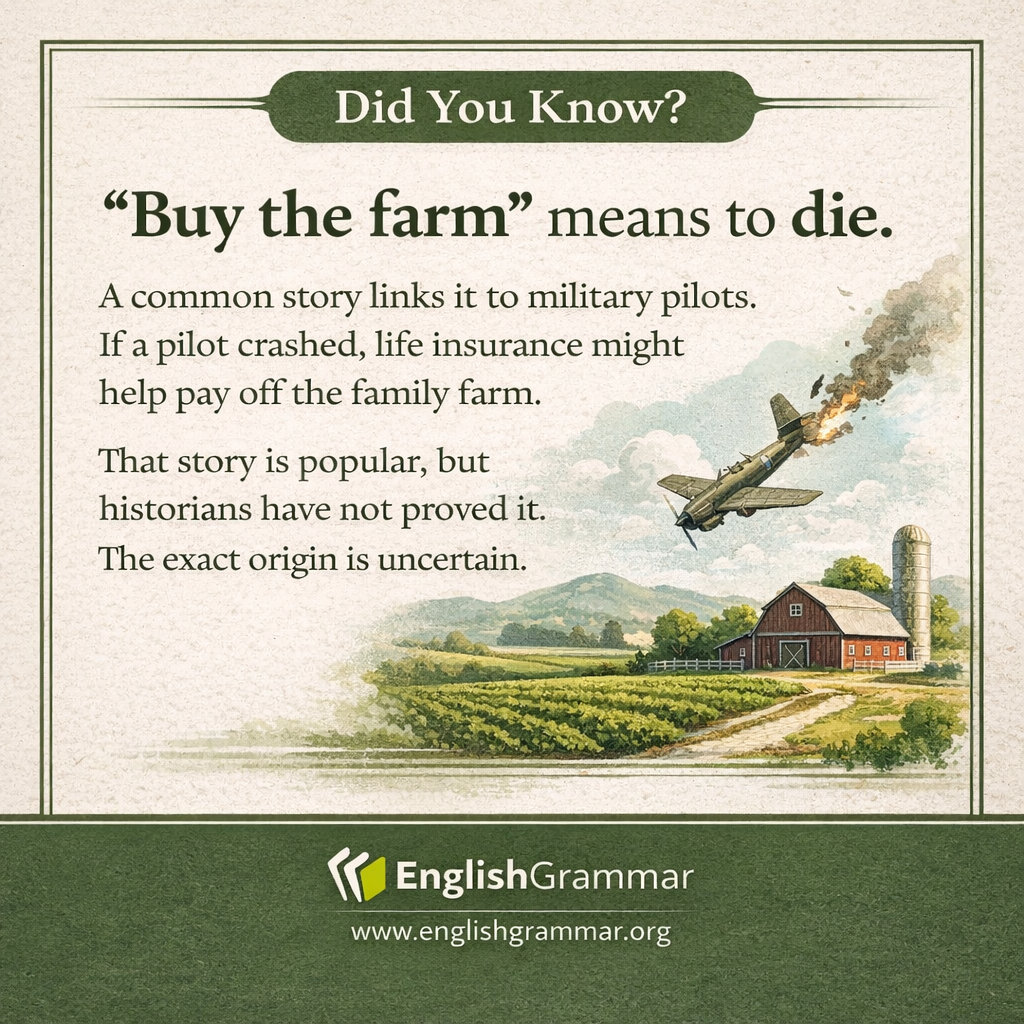
“Buy the farm” is an informal American expression meaning to die, especially in older slang. For example, someone might say, “That risky stunt could make you buy the farm.”

The most repeated explanation connects the phrase to military pilots, especially in the mid 1900s. According to that story, if a pilot was killed in a crash, a life insurance payment might be enough to help the family pay off a farm mortgage or even purchase the family farm outright. That idea is memorable, which is one reason it spread so widely.

However, the problem is evidence. Researchers and language historians have not found solid proof that this is the true origin. The phrase does appear in military related slang, but a popular explanation is not always the same thing as a documented one.

What can we say with confidence?

  • It means to die.
  • It became especially associated with American slang.
  • The pilot insurance story is possible, but not proven.
  • The exact origin remains uncertain.

So the phrase is real, but the neat origin story should be treated carefully. In etymology, a good story is not enough without strong historical evidence.

Improve your English grammar, vocabulary and writing

We take you step by step from beginner to advanced, even if you struggled with English at school or have always had trouble remembering the rules.

  • 10 modules, 112 lessons and 730 questions
  • Just log in and learn anytime and anywhere
  • Your progress is saved in your account
  • Download the 2027 Grammar Guide (PDF)
Join free

Already have an account? Sign in

See what’s in the course

Primary Sidebar

2.4M760.9K165.9K

Free 2027 Grammar Guide

  • Download Grammar Guide (PDF)
  • Online grammar course, A1 to C2
  • Weekly exercises and vocabulary
  • Join over 3 million English learners

We respect your privacy. Unsubscribe anytime.

Already have an account? Sign in

Grammar Checker - Try Now

Latest Posts

  • “How come?” has meant “why?” since the 1800s November 3, 2026
  • 100 Best Synonyms for “Vary” November 3, 2026
  • 100 Best Synonyms for “Individuals” November 3, 2026
  • Temporary vs. passing vs. fleeting vs. transient vs. ephemeral vs. evanescent November 3, 2026
  • 100 Best Synonyms for “Restless” November 3, 2026
  • Hard, firm, solid, rigid, stiff and unyielding: How to choose November 3, 2026
  • The origin of “out of the blue” November 3, 2026
  • 100 Best Synonyms for “Individualised” November 3, 2026
  • 100 Best Synonyms for “Varied” November 3, 2026
  • Fewer vs. less: counting things and measuring amounts November 3, 2026
Home of English Grammar

Free English grammar exercises, rules and vocabulary lists, with new exercises every week. Join the leading English grammar site with over 3 million followers.

Join free

Learn

  • Exercises
  • Matches
  • Grammar rules
  • Vocabulary lists
  • Writing guides
  • Online tools

More

  • Top social media posts
  • Various posts
  • Contact

Account

  • Join free
  • Grammar Course
  • Free grammar guide (PDF)

Copyright © 2026 EnglishGrammar.org

  • Disclaimer
  • Privacy policy
  • Terms
  • Sitemap