Home of English Grammar

Grammar Guide
  • Home
  • Exercises
  • Matches
  • Rules
  • Tools
    • Grammar Checker
    • Very Replacer
    • Word Counter
  • Top Social Media Posts
  • Various Posts
  • Vocabulary
  • Writing Guides
  • Contact

What “close but no cigar” means, and where it probably came from

May 16, 2026 - pdf

The origin of "close but no cigar"

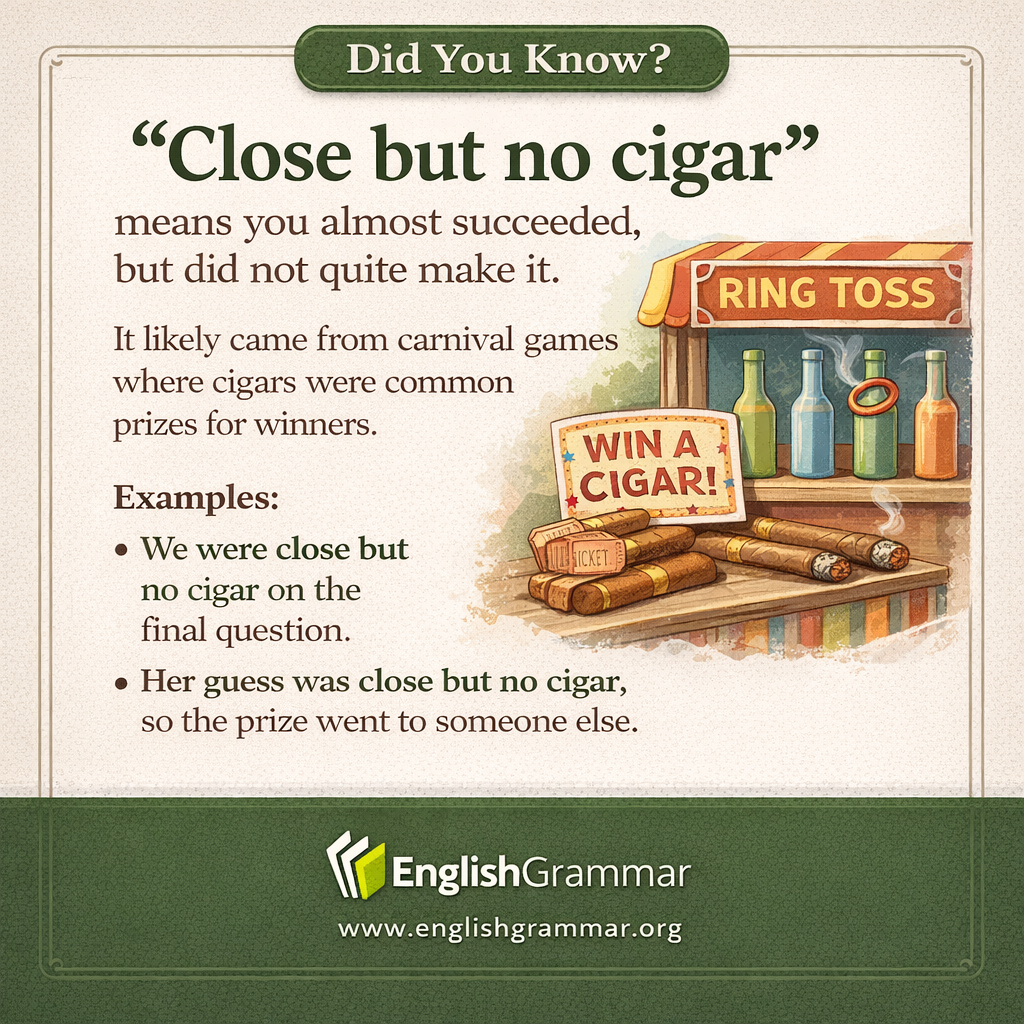
“Close but no cigar” means that someone came very near to success but still failed to get the result. It is often used when an answer, guess, or effort is almost right, yet not right enough.

The phrase probably comes from old carnival and fairground games. In the past, cigars were common prizes. If a player nearly won but missed the target, they got nothing, so they were close, but there was no cigar to take home. That clear image helps explain why the expression still means almost, but not quite.

People now use it in everyday situations, not just games.

  • We were close but no cigar on the final question.
  • His estimate was close but no cigar, so the contract went to another company.

The tone is usually informal and a little playful. It can soften disappointment, especially when someone made a good effort. You would not usually use it in very formal writing, but it is common in conversation, journalism, and casual business talk.

A good simple paraphrase is: almost successful, but unsuccessful in the end.

  • Share
  • Post
  • Post
  • Email
NEW: Try Matches, our daily vocabulary challenge. Pick a topic and level and match words with definitions to boost your vocabulary.
2,485,429 
761,532 
Improve Your Grammar
  • Download 2026 Grammar Guide (PDF)
  • Free Weekly Exercises & Vocabulary
  • Join over 3 Million English Learners
We respect your privacy. Unsubscribe anytime.

Grammar Checker

GrammarCheck.net - Try online
Hint → Bookmark GrammarCheck for future use.

Latest Posts

  • What “close but no cigar” means, and where it probably came from May 16, 2026
  • 100 Words Every Organ Donor Should Know May 16, 2026
  • Gruntled is a real word, and it means pleased May 16, 2026
  • Appraise vs. apprise: what is the difference? May 16, 2026
  • 100 Best Synonyms for “Uplifting” May 16, 2026
  • 100 Best Synonyms for “Erratic” May 16, 2026
  • The origin of “turn a blind eye” May 16, 2026

Copyright © 2026 · EnglishGrammar.org
Disclaimer · Privacy Policy · Sitemap · Terms

Improve Your Grammar
  • Download 2026 Grammar Guide (PDF)
  • Free Weekly Exercises & Vocabulary
  • Join over 3 Million English Learners
We respect your privacy. Unsubscribe anytime.