| No. | Item | Definition |
|---|---|---|
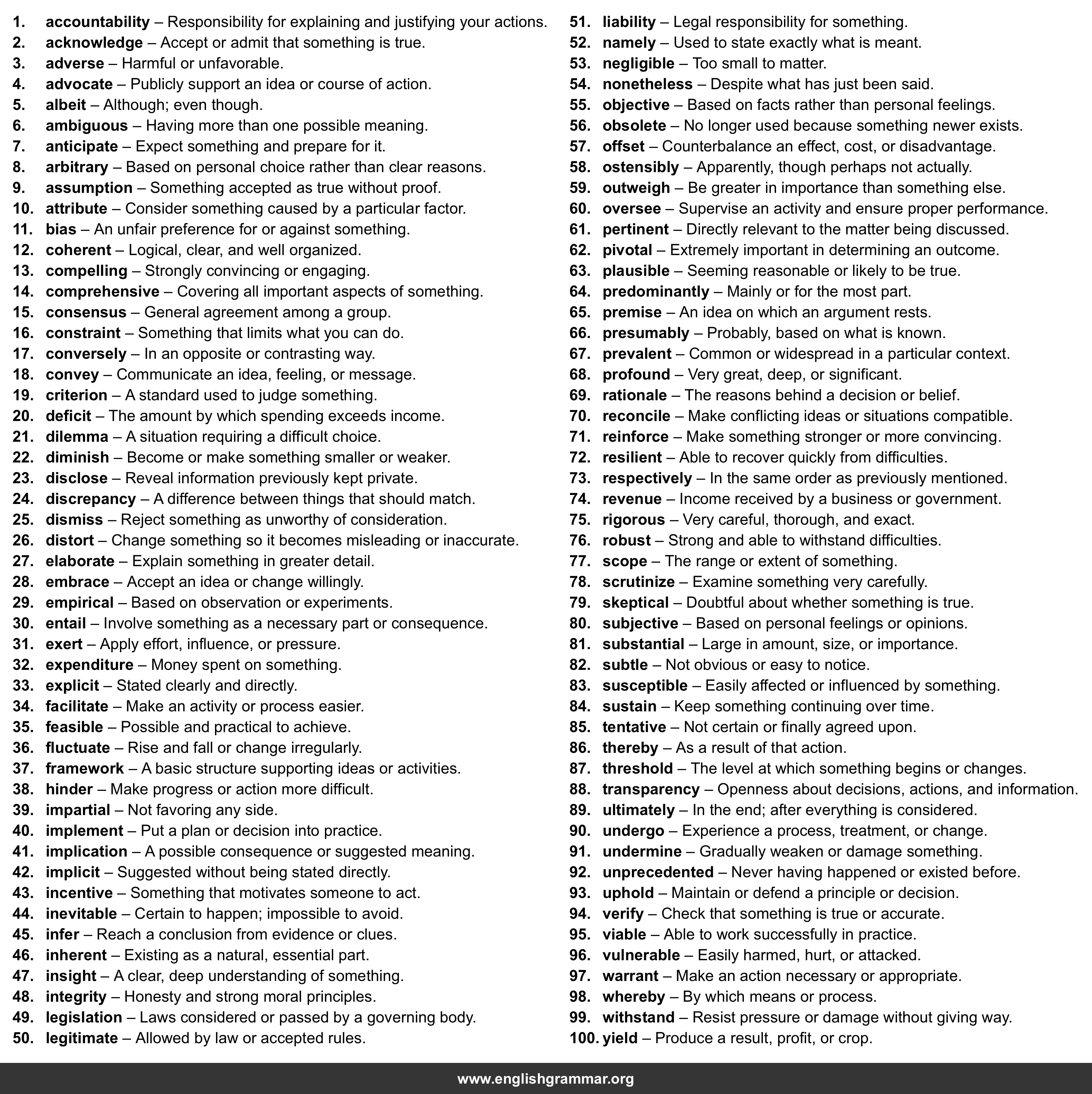
| 1. | accountability | Responsibility for explaining and justifying your actions. |
| 2. | acknowledge | Accept or admit that something is true. |
| 3. | adverse | Harmful or unfavorable. |
| 4. | advocate | Publicly support an idea or course of action. |
| 5. | albeit | Although; even though. |
| 6. | ambiguous | Having more than one possible meaning. |
| 7. | anticipate | Expect something and prepare for it. |
| 8. | arbitrary | Based on personal choice rather than clear reasons. |
| 9. | assumption | Something accepted as true without proof. |
| 10. | attribute | Consider something caused by a particular factor. |
| 11. | bias | An unfair preference for or against something. |
| 12. | coherent | Logical, clear, and well organized. |
| 13. | compelling | Strongly convincing or engaging. |
| 14. | comprehensive | Covering all important aspects of something. |
| 15. | consensus | General agreement among a group. |
| 16. | constraint | Something that limits what you can do. |
| 17. | conversely | In an opposite or contrasting way. |
| 18. | convey | Communicate an idea, feeling, or message. |
| 19. | criterion | A standard used to judge something. |
| 20. | deficit | The amount by which spending exceeds income. |
| 21. | dilemma | A situation requiring a difficult choice. |
| 22. | diminish | Become or make something smaller or weaker. |
| 23. | disclose | Reveal information previously kept private. |
| 24. | discrepancy | A difference between things that should match. |
| 25. | dismiss | Reject something as unworthy of consideration. |
| 26. | distort | Change something so it becomes misleading or inaccurate. |
| 27. | elaborate | Explain something in greater detail. |
| 28. | embrace | Accept an idea or change willingly. |
| 29. | empirical | Based on observation or experiments. |
| 30. | entail | Involve something as a necessary part or consequence. |
| 31. | exert | Apply effort, influence, or pressure. |
| 32. | expenditure | Money spent on something. |
| 33. | explicit | Stated clearly and directly. |
| 34. | facilitate | Make an activity or process easier. |
| 35. | feasible | Possible and practical to achieve. |
| 36. | fluctuate | Rise and fall or change irregularly. |
| 37. | framework | A basic structure supporting ideas or activities. |
| 38. | hinder | Make progress or action more difficult. |
| 39. | impartial | Not favoring any side. |
| 40. | implement | Put a plan or decision into practice. |
| 41. | implication | A possible consequence or suggested meaning. |
| 42. | implicit | Suggested without being stated directly. |
| 43. | incentive | Something that motivates someone to act. |
| 44. | inevitable | Certain to happen; impossible to avoid. |
| 45. | infer | Reach a conclusion from evidence or clues. |
| 46. | inherent | Existing as a natural, essential part. |
| 47. | insight | A clear, deep understanding of something. |
| 48. | integrity | Honesty and strong moral principles. |
| 49. | legislation | Laws considered or passed by a governing body. |
| 50. | legitimate | Allowed by law or accepted rules. |
| 51. | liability | Legal responsibility for something. |
| 52. | namely | Used to state exactly what is meant. |
| 53. | negligible | Too small to matter. |
| 54. | nonetheless | Despite what has just been said. |
| 55. | objective | Based on facts rather than personal feelings. |
| 56. | obsolete | No longer used because something newer exists. |
| 57. | offset | Counterbalance an effect, cost, or disadvantage. |
| 58. | ostensibly | Apparently, though perhaps not actually. |
| 59. | outweigh | Be greater in importance than something else. |
| 60. | oversee | Supervise an activity and ensure proper performance. |
| 61. | pertinent | Directly relevant to the matter being discussed. |
| 62. | pivotal | Extremely important in determining an outcome. |
| 63. | plausible | Seeming reasonable or likely to be true. |
| 64. | predominantly | Mainly or for the most part. |
| 65. | premise | An idea on which an argument rests. |
| 66. | presumably | Probably, based on what is known. |
| 67. | prevalent | Common or widespread in a particular context. |
| 68. | profound | Very great, deep, or significant. |
| 69. | rationale | The reasons behind a decision or belief. |
| 70. | reconcile | Make conflicting ideas or situations compatible. |
| 71. | reinforce | Make something stronger or more convincing. |
| 72. | resilient | Able to recover quickly from difficulties. |
| 73. | respectively | In the same order as previously mentioned. |
| 74. | revenue | Income received by a business or government. |
| 75. | rigorous | Very careful, thorough, and exact. |
| 76. | robust | Strong and able to withstand difficulties. |
| 77. | scope | The range or extent of something. |
| 78. | scrutinize | Examine something very carefully. |
| 79. | skeptical | Doubtful about whether something is true. |
| 80. | subjective | Based on personal feelings or opinions. |
| 81. | substantial | Large in amount, size, or importance. |
| 82. | subtle | Not obvious or easy to notice. |
| 83. | susceptible | Easily affected or influenced by something. |
| 84. | sustain | Keep something continuing over time. |
| 85. | tentative | Not certain or finally agreed upon. |
| 86. | thereby | As a result of that action. |
| 87. | threshold | The level at which something begins or changes. |
| 88. | transparency | Openness about decisions, actions, and information. |
| 89. | ultimately | In the end; after everything is considered. |
| 90. | undergo | Experience a process, treatment, or change. |
| 91. | undermine | Gradually weaken or damage something. |
| 92. | unprecedented | Never having happened or existed before. |
| 93. | uphold | Maintain or defend a principle or decision. |
| 94. | verify | Check that something is true or accurate. |
| 95. | viable | Able to work successfully in practice. |
| 96. | vulnerable | Easily harmed, hurt, or attacked. |
| 97. | warrant | Make an action necessary or appropriate. |
| 98. | whereby | By which means or process. |
| 99. | withstand | Resist pressure or damage without giving way. |
| 100. | yield | Produce a result, profit, or crop. |
Vocabulary
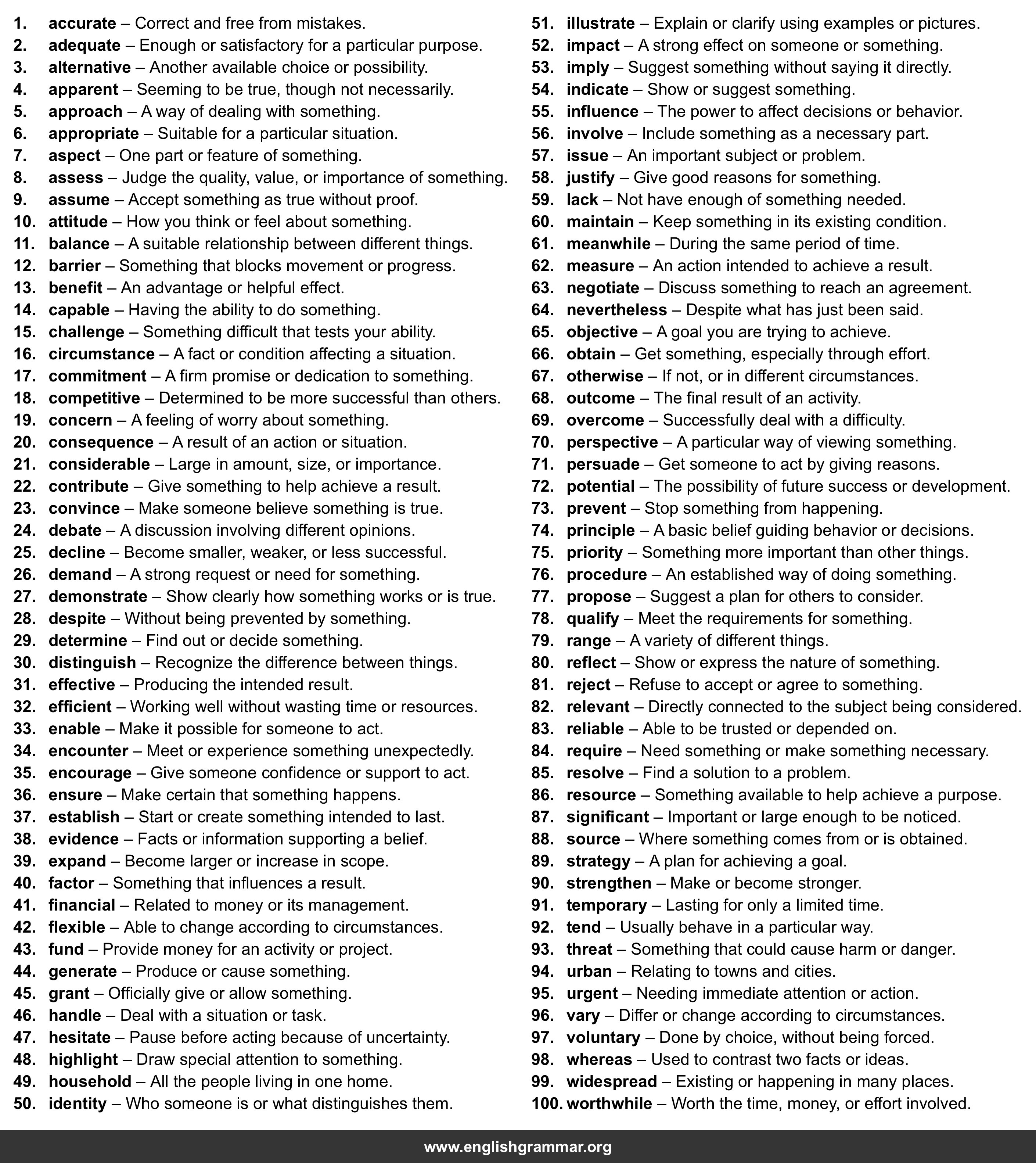
100 Words Every B2 English Learner Should Know
| No. | Item | Definition |
|---|---|---|
| 1. | accurate | Correct and free from mistakes. |
| 2. | adequate | Enough or satisfactory for a particular purpose. |
| 3. | alternative | Another available choice or possibility. |
| 4. | apparent | Seeming to be true, though not necessarily. |
| 5. | approach | A way of dealing with something. |
| 6. | appropriate | Suitable for a particular situation. |
| 7. | aspect | One part or feature of something. |
| 8. | assess | Judge the quality, value, or importance of something. |
| 9. | assume | Accept something as true without proof. |
| 10. | attitude | How you think or feel about something. |
| 11. | balance | A suitable relationship between different things. |
| 12. | barrier | Something that blocks movement or progress. |
| 13. | benefit | An advantage or helpful effect. |
| 14. | capable | Having the ability to do something. |
| 15. | challenge | Something difficult that tests your ability. |
| 16. | circumstance | A fact or condition affecting a situation. |
| 17. | commitment | A firm promise or dedication to something. |
| 18. | competitive | Determined to be more successful than others. |
| 19. | concern | A feeling of worry about something. |
| 20. | consequence | A result of an action or situation. |
| 21. | considerable | Large in amount, size, or importance. |
| 22. | contribute | Give something to help achieve a result. |
| 23. | convince | Make someone believe something is true. |
| 24. | debate | A discussion involving different opinions. |
| 25. | decline | Become smaller, weaker, or less successful. |
| 26. | demand | A strong request or need for something. |
| 27. | demonstrate | Show clearly how something works or is true. |
| 28. | despite | Without being prevented by something. |
| 29. | determine | Find out or decide something. |
| 30. | distinguish | Recognize the difference between things. |
| 31. | effective | Producing the intended result. |
| 32. | efficient | Working well without wasting time or resources. |
| 33. | enable | Make it possible for someone to act. |
| 34. | encounter | Meet or experience something unexpectedly. |
| 35. | encourage | Give someone confidence or support to act. |
| 36. | ensure | Make certain that something happens. |
| 37. | establish | Start or create something intended to last. |
| 38. | evidence | Facts or information supporting a belief. |
| 39. | expand | Become larger or increase in scope. |
| 40. | factor | Something that influences a result. |
| 41. | financial | Related to money or its management. |
| 42. | flexible | Able to change according to circumstances. |
| 43. | fund | Provide money for an activity or project. |
| 44. | generate | Produce or cause something. |
| 45. | grant | Officially give or allow something. |
| 46. | handle | Deal with a situation or task. |
| 47. | hesitate | Pause before acting because of uncertainty. |
| 48. | highlight | Draw special attention to something. |
| 49. | household | All the people living in one home. |
| 50. | identity | Who someone is or what distinguishes them. |
| 51. | illustrate | Explain or clarify using examples or pictures. |
| 52. | impact | A strong effect on someone or something. |
| 53. | imply | Suggest something without saying it directly. |
| 54. | indicate | Show or suggest something. |
| 55. | influence | The power to affect decisions or behavior. |
| 56. | involve | Include something as a necessary part. |
| 57. | issue | An important subject or problem. |
| 58. | justify | Give good reasons for something. |
| 59. | lack | Not have enough of something needed. |
| 60. | maintain | Keep something in its existing condition. |
| 61. | meanwhile | During the same period of time. |
| 62. | measure | An action intended to achieve a result. |
| 63. | negotiate | Discuss something to reach an agreement. |
| 64. | nevertheless | Despite what has just been said. |
| 65. | objective | A goal you are trying to achieve. |
| 66. | obtain | Get something, especially through effort. |
| 67. | otherwise | If not, or in different circumstances. |
| 68. | outcome | The final result of an activity. |
| 69. | overcome | Successfully deal with a difficulty. |
| 70. | perspective | A particular way of viewing something. |
| 71. | persuade | Get someone to act by giving reasons. |
| 72. | potential | The possibility of future success or development. |
| 73. | prevent | Stop something from happening. |
| 74. | principle | A basic belief guiding behavior or decisions. |
| 75. | priority | Something more important than other things. |
| 76. | procedure | An established way of doing something. |
| 77. | propose | Suggest a plan for others to consider. |
| 78. | qualify | Meet the requirements for something. |
| 79. | range | A variety of different things. |
| 80. | reflect | Show or express the nature of something. |
| 81. | reject | Refuse to accept or agree to something. |
| 82. | relevant | Directly connected to the subject being considered. |
| 83. | reliable | Able to be trusted or depended on. |
| 84. | require | Need something or make something necessary. |
| 85. | resolve | Find a solution to a problem. |
| 86. | resource | Something available to help achieve a purpose. |
| 87. | significant | Important or large enough to be noticed. |
| 88. | source | Where something comes from or is obtained. |
| 89. | strategy | A plan for achieving a goal. |
| 90. | strengthen | Make or become stronger. |
| 91. | temporary | Lasting for only a limited time. |
| 92. | tend | Usually behave in a particular way. |
| 93. | threat | Something that could cause harm or danger. |
| 94. | urban | Relating to towns and cities. |
| 95. | urgent | Needing immediate attention or action. |
| 96. | vary | Differ or change according to circumstances. |
| 97. | voluntary | Done by choice, without being forced. |
| 98. | whereas | Used to contrast two facts or ideas. |
| 99. | widespread | Existing or happening in many places. |
| 100. | worthwhile | Worth the time, money, or effort involved. |
100 Words Every B1 English Learner Should Know
| No. | Item | Definition |
|---|---|---|
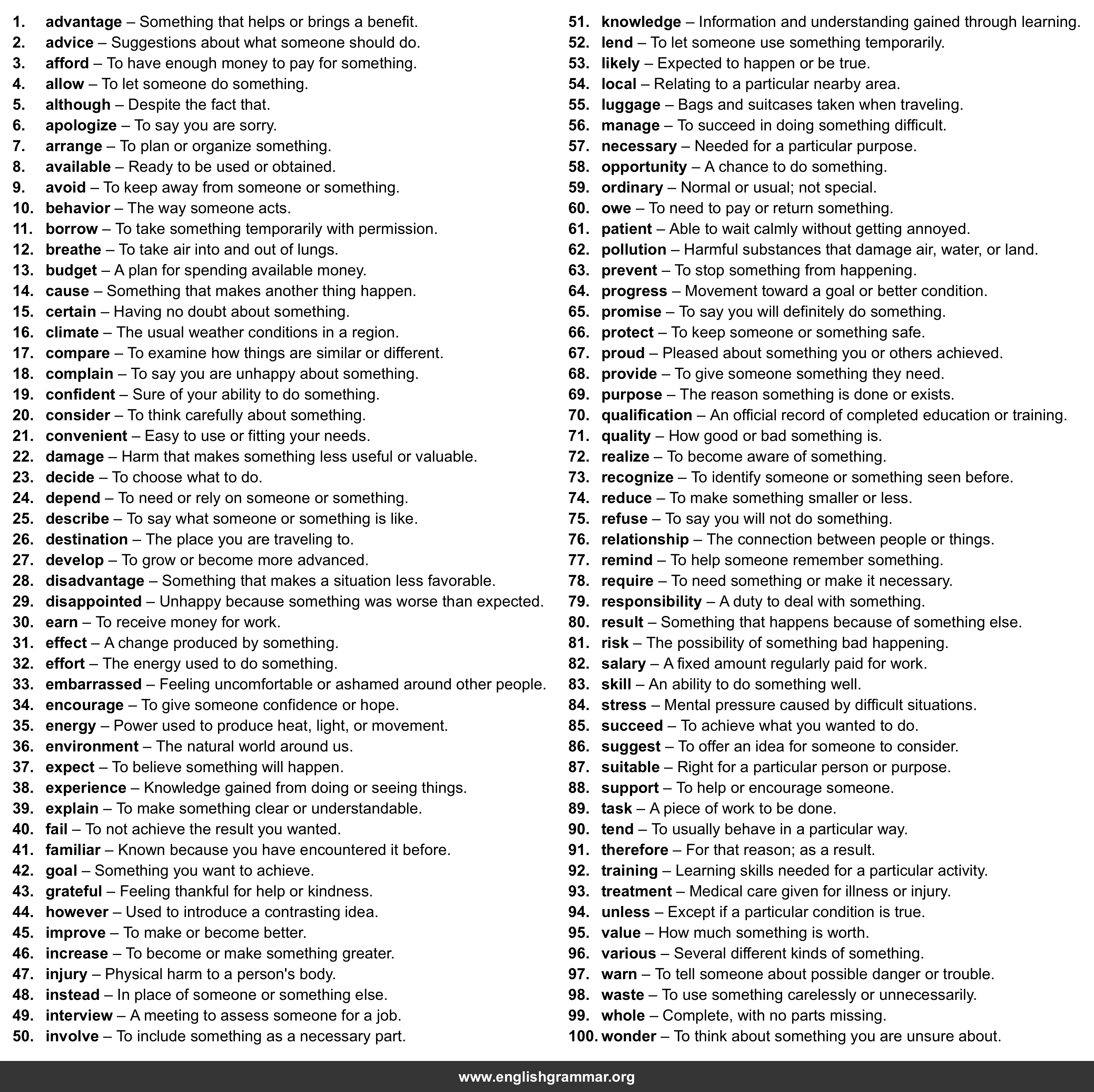
| 1. | advantage | Something that helps or brings a benefit. |
| 2. | advice | Suggestions about what someone should do. |
| 3. | afford | To have enough money to pay for something. |
| 4. | allow | To let someone do something. |
| 5. | although | Despite the fact that. |
| 6. | apologize | To say you are sorry. |
| 7. | arrange | To plan or organize something. |
| 8. | available | Ready to be used or obtained. |
| 9. | avoid | To keep away from someone or something. |
| 10. | behavior | The way someone acts. |
| 11. | borrow | To take something temporarily with permission. |
| 12. | breathe | To take air into and out of lungs. |
| 13. | budget | A plan for spending available money. |
| 14. | cause | Something that makes another thing happen. |
| 15. | certain | Having no doubt about something. |
| 16. | climate | The usual weather conditions in a region. |
| 17. | compare | To examine how things are similar or different. |
| 18. | complain | To say you are unhappy about something. |
| 19. | confident | Sure of your ability to do something. |
| 20. | consider | To think carefully about something. |
| 21. | convenient | Easy to use or fitting your needs. |
| 22. | damage | Harm that makes something less useful or valuable. |
| 23. | decide | To choose what to do. |
| 24. | depend | To need or rely on someone or something. |
| 25. | describe | To say what someone or something is like. |
| 26. | destination | The place you are traveling to. |
| 27. | develop | To grow or become more advanced. |
| 28. | disadvantage | Something that makes a situation less favorable. |
| 29. | disappointed | Unhappy because something was worse than expected. |
| 30. | earn | To receive money for work. |
| 31. | effect | A change produced by something. |
| 32. | effort | The energy used to do something. |
| 33. | embarrassed | Feeling uncomfortable or ashamed around other people. |
| 34. | encourage | To give someone confidence or hope. |
| 35. | energy | Power used to produce heat, light, or movement. |
| 36. | environment | The natural world around us. |
| 37. | expect | To believe something will happen. |
| 38. | experience | Knowledge gained from doing or seeing things. |
| 39. | explain | To make something clear or understandable. |
| 40. | fail | To not achieve the result you wanted. |
| 41. | familiar | Known because you have encountered it before. |
| 42. | goal | Something you want to achieve. |
| 43. | grateful | Feeling thankful for help or kindness. |
| 44. | however | Used to introduce a contrasting idea. |
| 45. | improve | To make or become better. |
| 46. | increase | To become or make something greater. |
| 47. | injury | Physical harm to a person’s body. |
| 48. | instead | In place of someone or something else. |
| 49. | interview | A meeting to assess someone for a job. |
| 50. | involve | To include something as a necessary part. |
| 51. | knowledge | Information and understanding gained through learning. |
| 52. | lend | To let someone use something temporarily. |
| 53. | likely | Expected to happen or be true. |
| 54. | local | Relating to a particular nearby area. |
| 55. | luggage | Bags and suitcases taken when traveling. |
| 56. | manage | To succeed in doing something difficult. |
| 57. | necessary | Needed for a particular purpose. |
| 58. | opportunity | A chance to do something. |
| 59. | ordinary | Normal or usual; not special. |
| 60. | owe | To need to pay or return something. |
| 61. | patient | Able to wait calmly without getting annoyed. |
| 62. | pollution | Harmful substances that damage air, water, or land. |
| 63. | prevent | To stop something from happening. |
| 64. | progress | Movement toward a goal or better condition. |
| 65. | promise | To say you will definitely do something. |
| 66. | protect | To keep someone or something safe. |
| 67. | proud | Pleased about something you or others achieved. |
| 68. | provide | To give someone something they need. |
| 69. | purpose | The reason something is done or exists. |
| 70. | qualification | An official record of completed education or training. |
| 71. | quality | How good or bad something is. |
| 72. | realize | To become aware of something. |
| 73. | recognize | To identify someone or something seen before. |
| 74. | reduce | To make something smaller or less. |
| 75. | refuse | To say you will not do something. |
| 76. | relationship | The connection between people or things. |
| 77. | remind | To help someone remember something. |
| 78. | require | To need something or make it necessary. |
| 79. | responsibility | A duty to deal with something. |
| 80. | result | Something that happens because of something else. |
| 81. | risk | The possibility of something bad happening. |
| 82. | salary | A fixed amount regularly paid for work. |
| 83. | skill | An ability to do something well. |
| 84. | stress | Mental pressure caused by difficult situations. |
| 85. | succeed | To achieve what you wanted to do. |
| 86. | suggest | To offer an idea for someone to consider. |
| 87. | suitable | Right for a particular person or purpose. |
| 88. | support | To help or encourage someone. |
| 89. | task | A piece of work to be done. |
| 90. | tend | To usually behave in a particular way. |
| 91. | therefore | For that reason; as a result. |
| 92. | training | Learning skills needed for a particular activity. |
| 93. | treatment | Medical care given for illness or injury. |
| 94. | unless | Except if a particular condition is true. |
| 95. | value | How much something is worth. |
| 96. | various | Several different kinds of something. |
| 97. | warn | To tell someone about possible danger or trouble. |
| 98. | waste | To use something carelessly or unnecessarily. |
| 99. | whole | Complete, with no parts missing. |
| 100. | wonder | To think about something you are unsure about. |
100 Words Every A2 English Learner Should Know
| No. | Item | Definition |
|---|---|---|
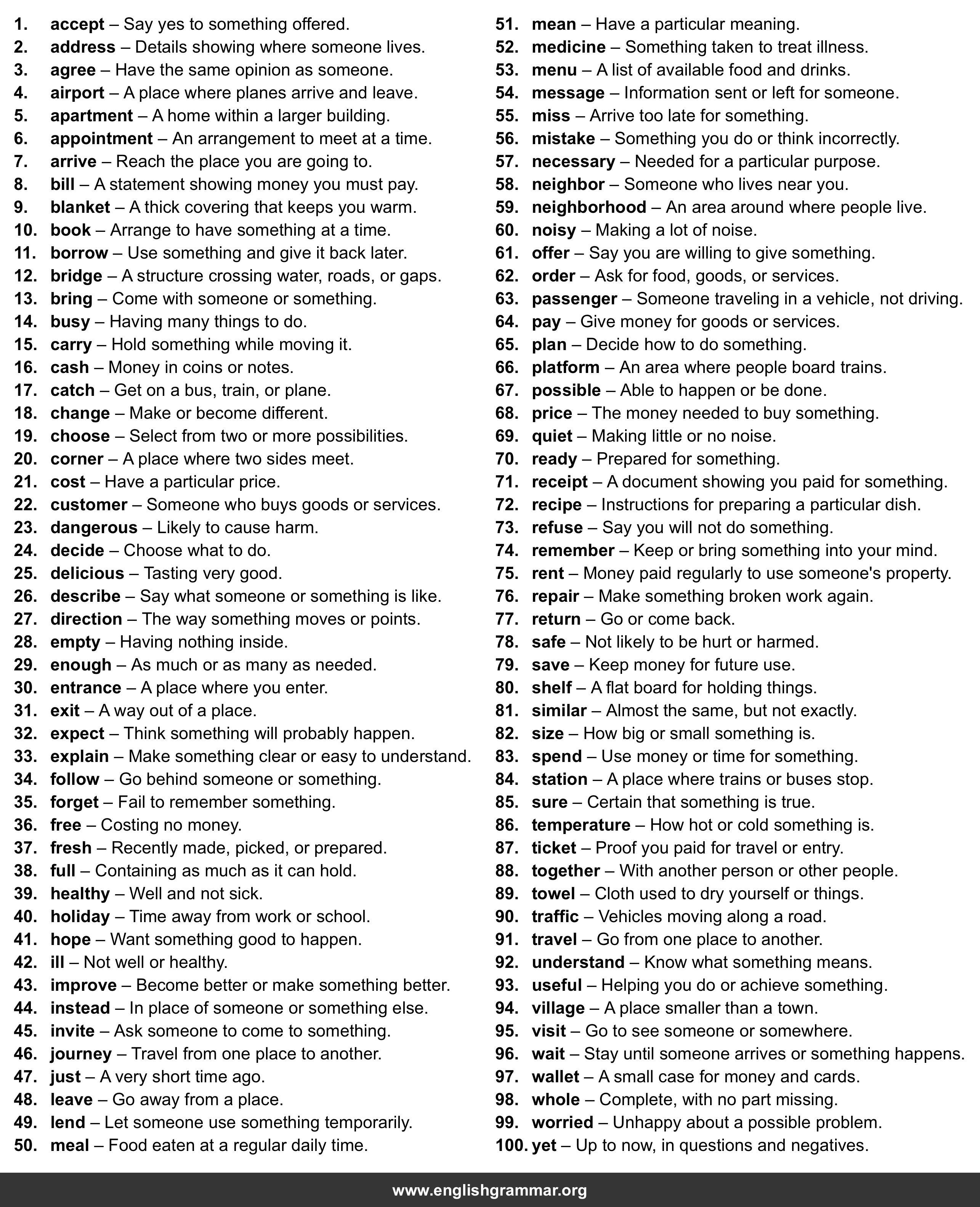
| 1. | accept | Say yes to something offered. |
| 2. | address | Details showing where someone lives. |
| 3. | agree | Have the same opinion as someone. |
| 4. | airport | A place where planes arrive and leave. |
| 5. | apartment | A home within a larger building. |
| 6. | appointment | An arrangement to meet at a time. |
| 7. | arrive | Reach the place you are going to. |
| 8. | bill | A statement showing money you must pay. |
| 9. | blanket | A thick covering that keeps you warm. |
| 10. | book | Arrange to have something at a time. |
| 11. | borrow | Use something and give it back later. |
| 12. | bridge | A structure crossing water, roads, or gaps. |
| 13. | bring | Come with someone or something. |
| 14. | busy | Having many things to do. |
| 15. | carry | Hold something while moving it. |
| 16. | cash | Money in coins or notes. |
| 17. | catch | Get on a bus, train, or plane. |
| 18. | change | Make or become different. |
| 19. | choose | Select from two or more possibilities. |
| 20. | corner | A place where two sides meet. |
| 21. | cost | Have a particular price. |
| 22. | customer | Someone who buys goods or services. |
| 23. | dangerous | Likely to cause harm. |
| 24. | decide | Choose what to do. |
| 25. | delicious | Tasting very good. |
| 26. | describe | Say what someone or something is like. |
| 27. | direction | The way something moves or points. |
| 28. | empty | Having nothing inside. |
| 29. | enough | As much or as many as needed. |
| 30. | entrance | A place where you enter. |
| 31. | exit | A way out of a place. |
| 32. | expect | Think something will probably happen. |
| 33. | explain | Make something clear or easy to understand. |
| 34. | follow | Go behind someone or something. |
| 35. | forget | Fail to remember something. |
| 36. | free | Costing no money. |
| 37. | fresh | Recently made, picked, or prepared. |
| 38. | full | Containing as much as it can hold. |
| 39. | healthy | Well and not sick. |
| 40. | holiday | Time away from work or school. |
| 41. | hope | Want something good to happen. |
| 42. | ill | Not well or healthy. |
| 43. | improve | Become better or make something better. |
| 44. | instead | In place of someone or something else. |
| 45. | invite | Ask someone to come to something. |
| 46. | journey | Travel from one place to another. |
| 47. | just | A very short time ago. |
| 48. | leave | Go away from a place. |
| 49. | lend | Let someone use something temporarily. |
| 50. | meal | Food eaten at a regular daily time. |
| 51. | mean | Have a particular meaning. |
| 52. | medicine | Something taken to treat illness. |
| 53. | menu | A list of available food and drinks. |
| 54. | message | Information sent or left for someone. |
| 55. | miss | Arrive too late for something. |
| 56. | mistake | Something you do or think incorrectly. |
| 57. | necessary | Needed for a particular purpose. |
| 58. | neighbor | Someone who lives near you. |
| 59. | neighborhood | An area around where people live. |
| 60. | noisy | Making a lot of noise. |
| 61. | offer | Say you are willing to give something. |
| 62. | order | Ask for food, goods, or services. |
| 63. | passenger | Someone traveling in a vehicle, not driving. |
| 64. | pay | Give money for goods or services. |
| 65. | plan | Decide how to do something. |
| 66. | platform | An area where people board trains. |
| 67. | possible | Able to happen or be done. |
| 68. | price | The money needed to buy something. |
| 69. | quiet | Making little or no noise. |
| 70. | ready | Prepared for something. |
| 71. | receipt | A document showing you paid for something. |
| 72. | recipe | Instructions for preparing a particular dish. |
| 73. | refuse | Say you will not do something. |
| 74. | remember | Keep or bring something into your mind. |
| 75. | rent | Money paid regularly to use someone’s property. |
| 76. | repair | Make something broken work again. |
| 77. | return | Go or come back. |
| 78. | safe | Not likely to be hurt or harmed. |
| 79. | save | Keep money for future use. |
| 80. | shelf | A flat board for holding things. |
| 81. | similar | Almost the same, but not exactly. |
| 82. | size | How big or small something is. |
| 83. | spend | Use money or time for something. |
| 84. | station | A place where trains or buses stop. |
| 85. | sure | Certain that something is true. |
| 86. | temperature | How hot or cold something is. |
| 87. | ticket | Proof you paid for travel or entry. |
| 88. | together | With another person or other people. |
| 89. | towel | Cloth used to dry yourself or things. |
| 90. | traffic | Vehicles moving along a road. |
| 91. | travel | Go from one place to another. |
| 92. | understand | Know what something means. |
| 93. | useful | Helping you do or achieve something. |
| 94. | village | A place smaller than a town. |
| 95. | visit | Go to see someone or somewhere. |
| 96. | wait | Stay until someone arrives or something happens. |
| 97. | wallet | A small case for money and cards. |
| 98. | whole | Complete, with no part missing. |
| 99. | worried | Unhappy about a possible problem. |
| 100. | yet | Up to now, in questions and negatives. |
100 Words Every A1 English Learner Should Know
| No. | Item | Definition |
|---|---|---|
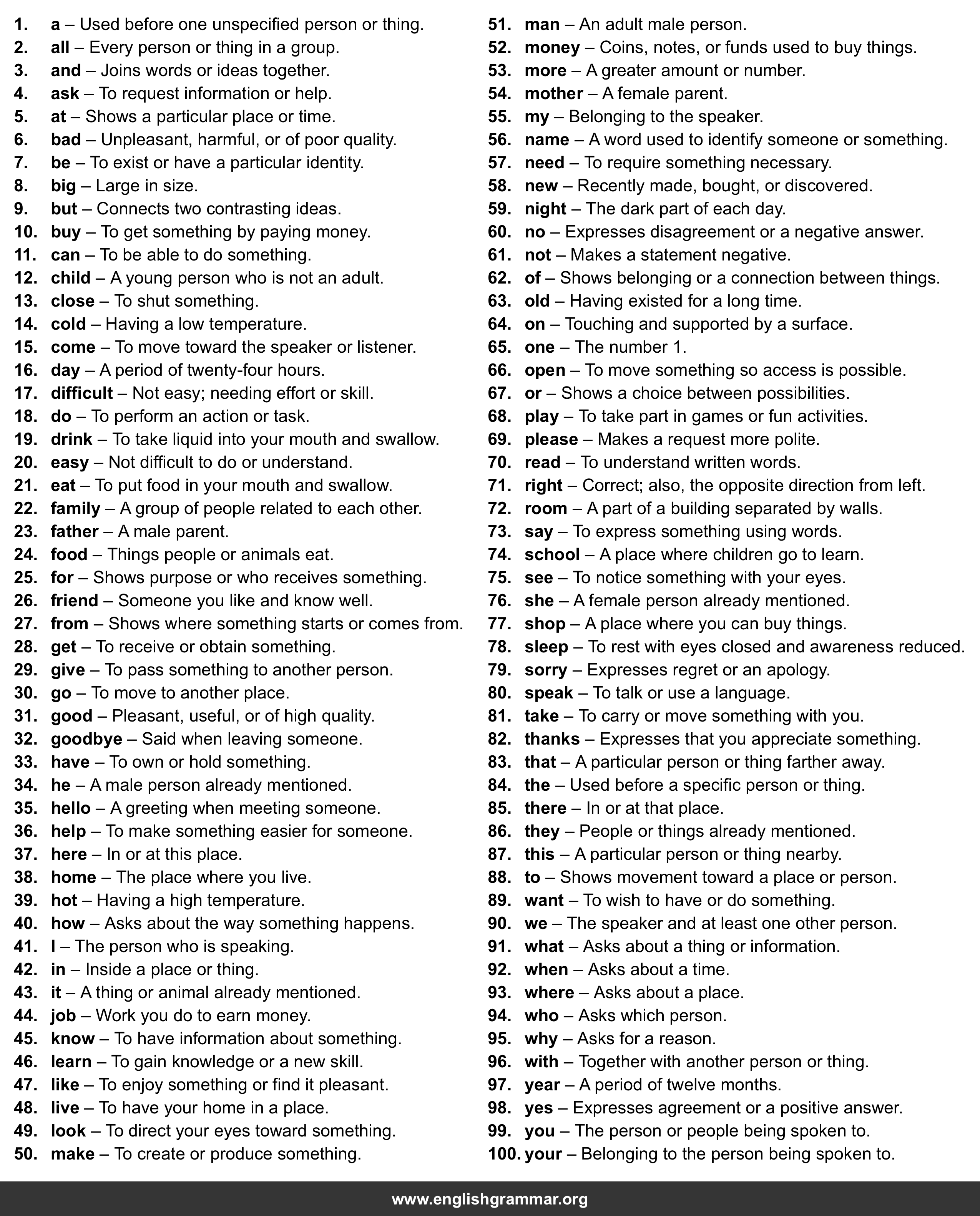
| 1. | a | Used before one unspecified person or thing. |
| 2. | all | Every person or thing in a group. |
| 3. | and | Joins words or ideas together. |
| 4. | ask | To request information or help. |
| 5. | at | Shows a particular place or time. |
| 6. | bad | Unpleasant, harmful, or of poor quality. |
| 7. | be | To exist or have a particular identity. |
| 8. | big | Large in size. |
| 9. | but | Connects two contrasting ideas. |
| 10. | buy | To get something by paying money. |
| 11. | can | To be able to do something. |
| 12. | child | A young person who is not an adult. |
| 13. | close | To shut something. |
| 14. | cold | Having a low temperature. |
| 15. | come | To move toward the speaker or listener. |
| 16. | day | A period of twenty-four hours. |
| 17. | difficult | Not easy; needing effort or skill. |
| 18. | do | To perform an action or task. |
| 19. | drink | To take liquid into your mouth and swallow. |
| 20. | easy | Not difficult to do or understand. |
| 21. | eat | To put food in your mouth and swallow. |
| 22. | family | A group of people related to each other. |
| 23. | father | A male parent. |
| 24. | food | Things people or animals eat. |
| 25. | for | Shows purpose or who receives something. |
| 26. | friend | Someone you like and know well. |
| 27. | from | Shows where something starts or comes from. |
| 28. | get | To receive or obtain something. |
| 29. | give | To pass something to another person. |
| 30. | go | To move to another place. |
| 31. | good | Pleasant, useful, or of high quality. |
| 32. | goodbye | Said when leaving someone. |
| 33. | have | To own or hold something. |
| 34. | he | A male person already mentioned. |
| 35. | hello | A greeting when meeting someone. |
| 36. | help | To make something easier for someone. |
| 37. | here | In or at this place. |
| 38. | home | The place where you live. |
| 39. | hot | Having a high temperature. |
| 40. | how | Asks about the way something happens. |
| 41. | I | The person who is speaking. |
| 42. | in | Inside a place or thing. |
| 43. | it | A thing or animal already mentioned. |
| 44. | job | Work you do to earn money. |
| 45. | know | To have information about something. |
| 46. | learn | To gain knowledge or a new skill. |
| 47. | like | To enjoy something or find it pleasant. |
| 48. | live | To have your home in a place. |
| 49. | look | To direct your eyes toward something. |
| 50. | make | To create or produce something. |
| 51. | man | An adult male person. |
| 52. | money | Coins, notes, or funds used to buy things. |
| 53. | more | A greater amount or number. |
| 54. | mother | A female parent. |
| 55. | my | Belonging to the speaker. |
| 56. | name | A word used to identify someone or something. |
| 57. | need | To require something necessary. |
| 58. | new | Recently made, bought, or discovered. |
| 59. | night | The dark part of each day. |
| 60. | no | Expresses disagreement or a negative answer. |
| 61. | not | Makes a statement negative. |
| 62. | of | Shows belonging or a connection between things. |
| 63. | old | Having existed for a long time. |
| 64. | on | Touching and supported by a surface. |
| 65. | one | The number 1. |
| 66. | open | To move something so access is possible. |
| 67. | or | Shows a choice between possibilities. |
| 68. | play | To take part in games or fun activities. |
| 69. | please | Makes a request more polite. |
| 70. | read | To understand written words. |
| 71. | right | Correct; also, the opposite direction from left. |
| 72. | room | A part of a building separated by walls. |
| 73. | say | To express something using words. |
| 74. | school | A place where children go to learn. |
| 75. | see | To notice something with your eyes. |
| 76. | she | A female person already mentioned. |
| 77. | shop | A place where you can buy things. |
| 78. | sleep | To rest with eyes closed and awareness reduced. |
| 79. | sorry | Expresses regret or an apology. |
| 80. | speak | To talk or use a language. |
| 81. | take | To carry or move something with you. |
| 82. | thanks | Expresses that you appreciate something. |
| 83. | that | A particular person or thing farther away. |
| 84. | the | Used before a specific person or thing. |
| 85. | there | In or at that place. |
| 86. | they | People or things already mentioned. |
| 87. | this | A particular person or thing nearby. |
| 88. | to | Shows movement toward a place or person. |
| 89. | want | To wish to have or do something. |
| 90. | we | The speaker and at least one other person. |
| 91. | what | Asks about a thing or information. |
| 92. | when | Asks about a time. |
| 93. | where | Asks about a place. |
| 94. | who | Asks which person. |
| 95. | why | Asks for a reason. |
| 96. | with | Together with another person or thing. |
| 97. | year | A period of twelve months. |
| 98. | yes | Expresses agreement or a positive answer. |
| 99. | you | The person or people being spoken to. |
| 100. | your | Belonging to the person being spoken to. |