• Skip to primary navigation
  • Skip to main content
  • Skip to primary sidebar
Home of English Grammar
  • Home
  • Exercises
  • Matches
  • Posts
  • Rules
  • Social Media Archive
  • Tools
    • Grammar Checker
    • Very Replacer
    • Word Counter
  • Vocabulary
  • Writing Guides
  • Pro

Vocabulary

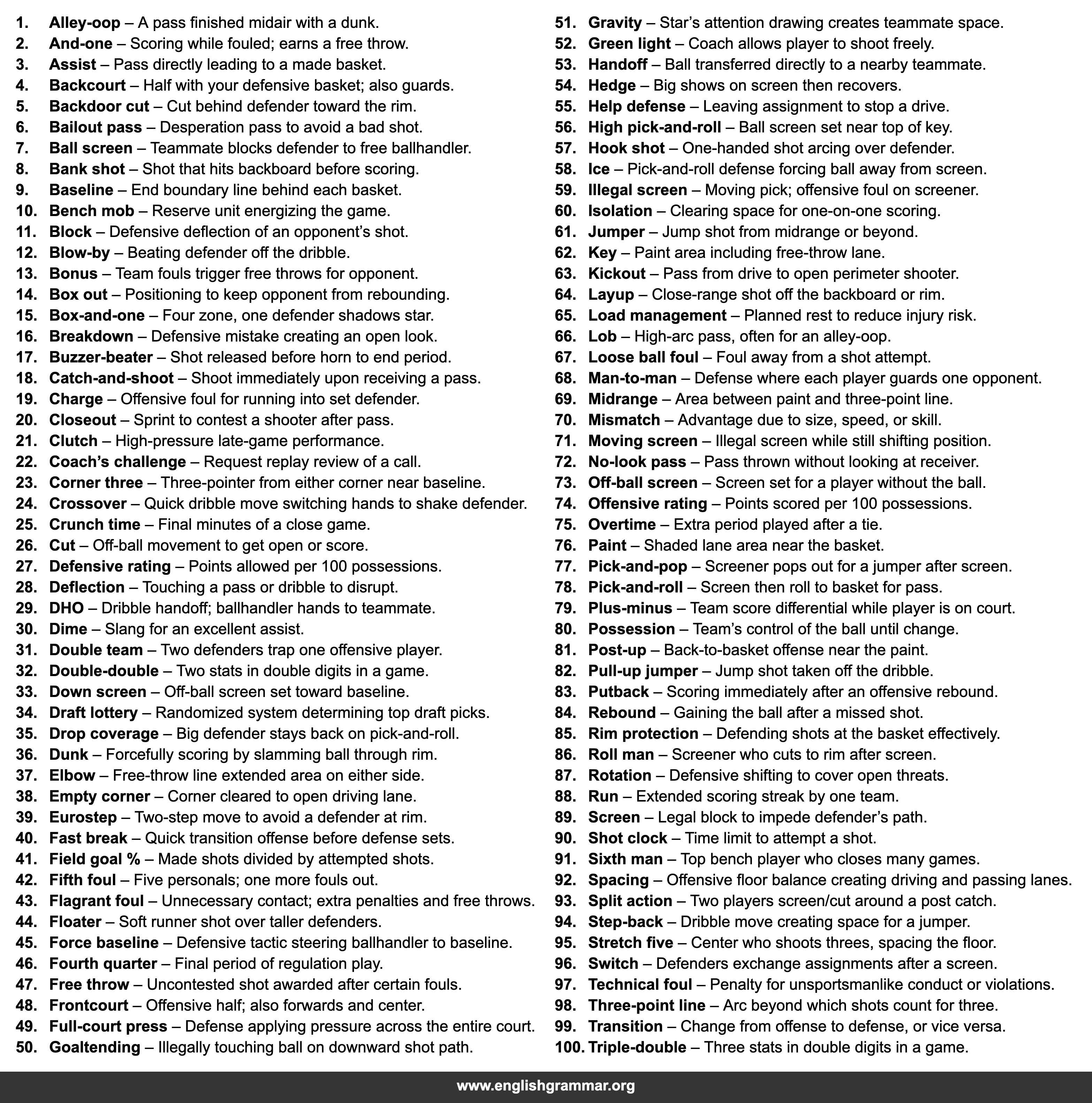
100 Words Every NBA Fan Should Know

January 18, 2026

No. Term Definition
1. Alley-oop A pass finished midair with a dunk.
2. And-one Scoring while fouled; earns a free throw.
3. Assist Pass directly leading to a made basket.
4. Backcourt Half with your defensive basket; also guards.
5. Backdoor cut Cut behind defender toward the rim.
6. Bailout pass Desperation pass to avoid a bad shot.
7. Ball screen Teammate blocks defender to free ballhandler.
8. Bank shot Shot that hits backboard before scoring.
9. Baseline End boundary line behind each basket.
10. Bench mob Reserve unit energizing the game.
11. Block Defensive deflection of an opponent’s shot.
12. Blow-by Beating defender off the dribble.
13. Bonus Team fouls trigger free throws for opponent.
14. Box out Positioning to keep opponent from rebounding.
15. Box-and-one Four zone, one defender shadows star.
16. Breakdown Defensive mistake creating an open look.
17. Buzzer-beater Shot released before horn to end period.
18. Catch-and-shoot Shoot immediately upon receiving a pass.
19. Charge Offensive foul for running into set defender.
20. Closeout Sprint to contest a shooter after pass.
21. Clutch High-pressure late-game performance.
22. Coach’s challenge Request replay review of a call.
23. Corner three Three-pointer from either corner near baseline.
24. Crossover Quick dribble move switching hands to shake defender.
25. Crunch time Final minutes of a close game.
26. Cut Off-ball movement to get open or score.
27. Defensive rating Points allowed per 100 possessions.
28. Deflection Touching a pass or dribble to disrupt.
29. DHO Dribble handoff; ballhandler hands to teammate.
30. Dime Slang for an excellent assist.
31. Double team Two defenders trap one offensive player.
32. Double-double Two stats in double digits in a game.
33. Down screen Off-ball screen set toward baseline.
34. Draft lottery Randomized system determining top draft picks.
35. Drop coverage Big defender stays back on pick-and-roll.
36. Dunk Forcefully scoring by slamming ball through rim.
37. Elbow Free-throw line extended area on either side.
38. Empty corner Corner cleared to open driving lane.
39. Eurostep Two-step move to avoid a defender at rim.
40. Fast break Quick transition offense before defense sets.
41. Field goal % Made shots divided by attempted shots.
42. Fifth foul Five personals; one more fouls out.
43. Flagrant foul Unnecessary contact; extra penalties and free throws.
44. Floater Soft runner shot over taller defenders.
45. Force baseline Defensive tactic steering ballhandler to baseline.
46. Fourth quarter Final period of regulation play.
47. Free throw Uncontested shot awarded after certain fouls.
48. Frontcourt Offensive half; also forwards and center.
49. Full-court press Defense applying pressure across the entire court.
50. Goaltending Illegally touching ball on downward shot path.
51. Gravity Star’s attention drawing creates teammate space.
52. Green light Coach allows player to shoot freely.
53. Handoff Ball transferred directly to a nearby teammate.
54. Hedge Big shows on screen then recovers.
55. Help defense Leaving assignment to stop a drive.
56. High pick-and-roll Ball screen set near top of key.
57. Hook shot One-handed shot arcing over defender.
58. Ice Pick-and-roll defense forcing ball away from screen.
59. Illegal screen Moving pick; offensive foul on screener.
60. Isolation Clearing space for one-on-one scoring.
61. Jumper Jump shot from midrange or beyond.
62. Key Paint area including free-throw lane.
63. Kickout Pass from drive to open perimeter shooter.
64. Layup Close-range shot off the backboard or rim.
65. Load management Planned rest to reduce injury risk.
66. Lob High-arc pass, often for an alley-oop.
67. Loose ball foul Foul away from a shot attempt.
68. Man-to-man Defense where each player guards one opponent.
69. Midrange Area between paint and three-point line.
70. Mismatch Advantage due to size, speed, or skill.
71. Moving screen Illegal screen while still shifting position.
72. No-look pass Pass thrown without looking at receiver.
73. Off-ball screen Screen set for a player without the ball.
74. Offensive rating Points scored per 100 possessions.
75. Overtime Extra period played after a tie.
76. Paint Shaded lane area near the basket.
77. Pick-and-pop Screener pops out for a jumper after screen.
78. Pick-and-roll Screen then roll to basket for pass.
79. Plus-minus Team score differential while player is on court.
80. Possession Team’s control of the ball until change.
81. Post-up Back-to-basket offense near the paint.
82. Pull-up jumper Jump shot taken off the dribble.
83. Putback Scoring immediately after an offensive rebound.
84. Rebound Gaining the ball after a missed shot.
85. Rim protection Defending shots at the basket effectively.
86. Roll man Screener who cuts to rim after screen.
87. Rotation Defensive shifting to cover open threats.
88. Run Extended scoring streak by one team.
89. Screen Legal block to impede defender’s path.
90. Shot clock Time limit to attempt a shot.
91. Sixth man Top bench player who closes many games.
92. Spacing Offensive floor balance creating driving and passing lanes.
93. Split action Two players screen/cut around a post catch.
94. Step-back Dribble move creating space for a jumper.
95. Stretch five Center who shoots threes, spacing the floor.
96. Switch Defenders exchange assignments after a screen.
97. Technical foul Penalty for unsportsmanlike conduct or violations.
98. Three-point line Arc beyond which shots count for three.
99. Transition Change from offense to defense, or vice versa.
100. Triple-double Three stats in double digits in a game.

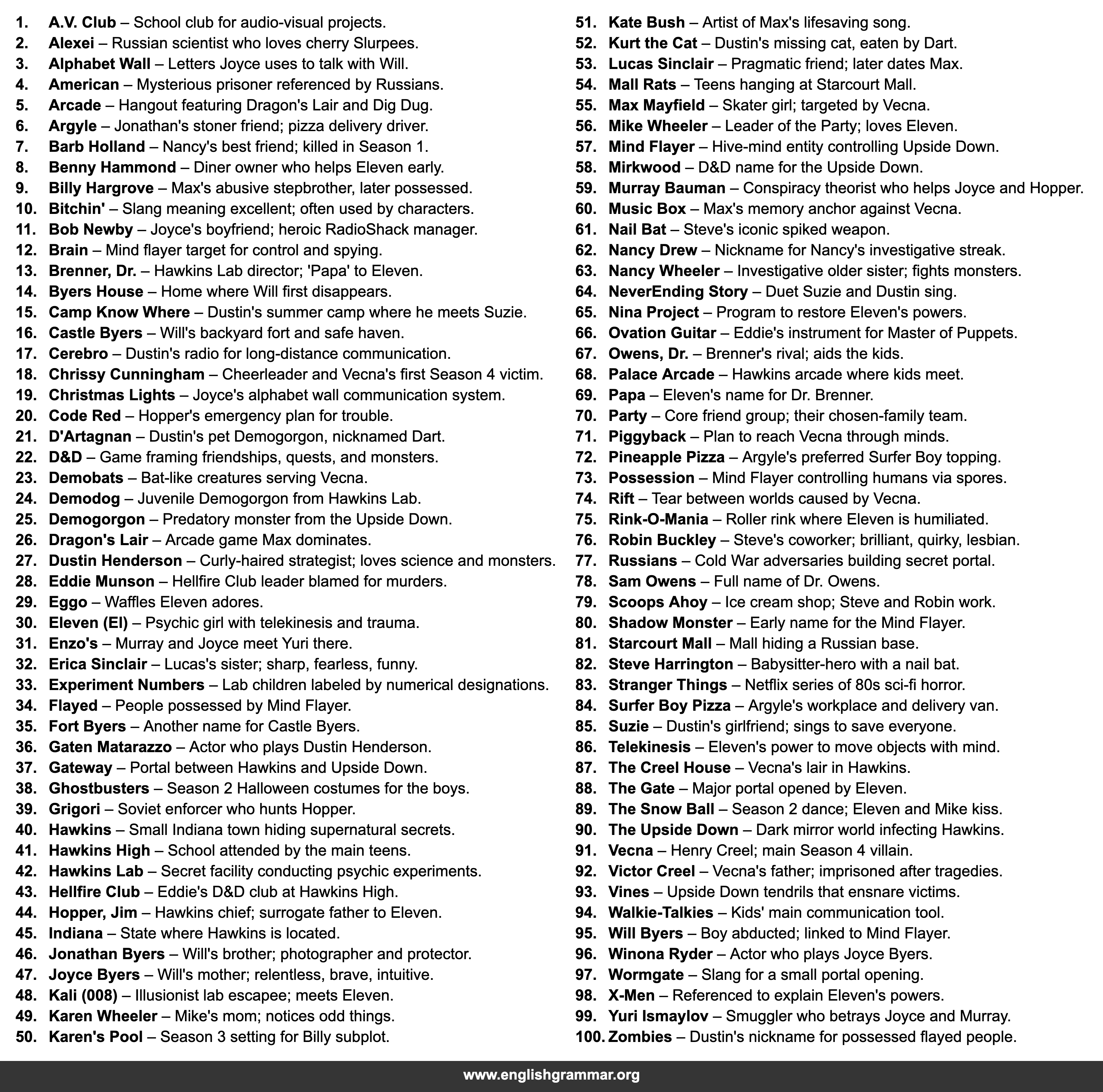
100 Terms Every Stranger Things Fan Should Know

January 17, 2026

No. Term Definition
1. A.V. Club School club for audio-visual projects.
2. Alexei Russian scientist who loves cherry Slurpees.
3. Alphabet Wall Letters Joyce uses to talk with Will.
4. American Mysterious prisoner referenced by Russians.
5. Arcade Hangout featuring Dragon’s Lair and Dig Dug.
6. Argyle Jonathan’s stoner friend; pizza delivery driver.
7. Barb Holland Nancy’s best friend; killed in Season 1.
8. Benny Hammond Diner owner who helps Eleven early.
9. Billy Hargrove Max’s abusive stepbrother, later possessed.
10. Bitchin’ Slang meaning excellent; often used by characters.
11. Bob Newby Joyce’s boyfriend; heroic RadioShack manager.
12. Brain Mind flayer target for control and spying.
13. Brenner, Dr. Hawkins Lab director; ‘Papa’ to Eleven.
14. Byers House Home where Will first disappears.
15. Camp Know Where Dustin’s summer camp where he meets Suzie.
16. Castle Byers Will’s backyard fort and safe haven.
17. Cerebro Dustin’s radio for long-distance communication.
18. Chrissy Cunningham Cheerleader and Vecna’s first Season 4 victim.
19. Christmas Lights Joyce’s alphabet wall communication system.
20. Code Red Hopper’s emergency plan for trouble.
21. D’Artagnan Dustin’s pet Demogorgon, nicknamed Dart.
22. D&D Game framing friendships, quests, and monsters.
23. Demobats Bat-like creatures serving Vecna.
24. Demodog Juvenile Demogorgon from Hawkins Lab.
25. Demogorgon Predatory monster from the Upside Down.
26. Dragon’s Lair Arcade game Max dominates.
27. Dustin Henderson Curly-haired strategist; loves science and monsters.
28. Eddie Munson Hellfire Club leader blamed for murders.
29. Eggo Waffles Eleven adores.
30. Eleven (El) Psychic girl with telekinesis and trauma.
31. Enzo’s Murray and Joyce meet Yuri there.
32. Erica Sinclair Lucas’s sister; sharp, fearless, funny.
33. Experiment Numbers Lab children labeled by numerical designations.
34. Flayed People possessed by Mind Flayer.
35. Fort Byers Another name for Castle Byers.
36. Gaten Matarazzo Actor who plays Dustin Henderson.
37. Gateway Portal between Hawkins and Upside Down.
38. Ghostbusters Season 2 Halloween costumes for the boys.
39. Grigori Soviet enforcer who hunts Hopper.
40. Hawkins Small Indiana town hiding supernatural secrets.
41. Hawkins High School attended by the main teens.
42. Hawkins Lab Secret facility conducting psychic experiments.
43. Hellfire Club Eddie’s D&D club at Hawkins High.
44. Hopper, Jim Hawkins chief; surrogate father to Eleven.
45. Indiana State where Hawkins is located.
46. Jonathan Byers Will’s brother; photographer and protector.
47. Joyce Byers Will’s mother; relentless, brave, intuitive.
48. Kali (008) Illusionist lab escapee; meets Eleven.
49. Karen Wheeler Mike’s mom; notices odd things.
50. Karen’s Pool Season 3 setting for Billy subplot.
51. Kate Bush Artist of Max’s lifesaving song.
52. Kurt the Cat Dustin’s missing cat, eaten by Dart.
53. Lucas Sinclair Pragmatic friend; later dates Max.
54. Mall Rats Teens hanging at Starcourt Mall.
55. Max Mayfield Skater girl; targeted by Vecna.
56. Mike Wheeler Leader of the Party; loves Eleven.
57. Mind Flayer Hive-mind entity controlling Upside Down.
58. Mirkwood D&D name for the Upside Down.
59. Murray Bauman Conspiracy theorist who helps Joyce and Hopper.
60. Music Box Max’s memory anchor against Vecna.
61. Nail Bat Steve’s iconic spiked weapon.
62. Nancy Drew Nickname for Nancy’s investigative streak.
63. Nancy Wheeler Investigative older sister; fights monsters.
64. NeverEnding Story Duet Suzie and Dustin sing.
65. Nina Project Program to restore Eleven’s powers.
66. Ovation Guitar Eddie’s instrument for Master of Puppets.
67. Owens, Dr. Brenner’s rival; aids the kids.
68. Palace Arcade Hawkins arcade where kids meet.
69. Papa Eleven’s name for Dr. Brenner.
70. Party Core friend group; their chosen-family team.
71. Piggyback Plan to reach Vecna through minds.
72. Pineapple Pizza Argyle’s preferred Surfer Boy topping.
73. Possession Mind Flayer controlling humans via spores.
74. Rift Tear between worlds caused by Vecna.
75. Rink-O-Mania Roller rink where Eleven is humiliated.
76. Robin Buckley Steve’s coworker; brilliant, quirky, lesbian.
77. Russians Cold War adversaries building secret portal.
78. Sam Owens Full name of Dr. Owens.
79. Scoops Ahoy Ice cream shop; Steve and Robin work.
80. Shadow Monster Early name for the Mind Flayer.
81. Starcourt Mall Mall hiding a Russian base.
82. Steve Harrington Babysitter-hero with a nail bat.
83. Stranger Things Netflix series of 80s sci-fi horror.
84. Surfer Boy Pizza Argyle’s workplace and delivery van.
85. Suzie Dustin’s girlfriend; sings to save everyone.
86. Telekinesis Eleven’s power to move objects with mind.
87. The Creel House Vecna’s lair in Hawkins.
88. The Gate Major portal opened by Eleven.
89. The Snow Ball Season 2 dance; Eleven and Mike kiss.
90. The Upside Down Dark mirror world infecting Hawkins.
91. Vecna Henry Creel; main Season 4 villain.
92. Victor Creel Vecna’s father; imprisoned after tragedies.
93. Vines Upside Down tendrils that ensnare victims.
94. Walkie-Talkies Kids’ main communication tool.
95. Will Byers Boy abducted; linked to Mind Flayer.
96. Winona Ryder Actor who plays Joyce Byers.
97. Wormgate Slang for a small portal opening.
98. X-Men Referenced to explain Eleven’s powers.
99. Yuri Ismaylov Smuggler who betrays Joyce and Murray.
100. Zombies Dustin’s nickname for possessed flayed people.

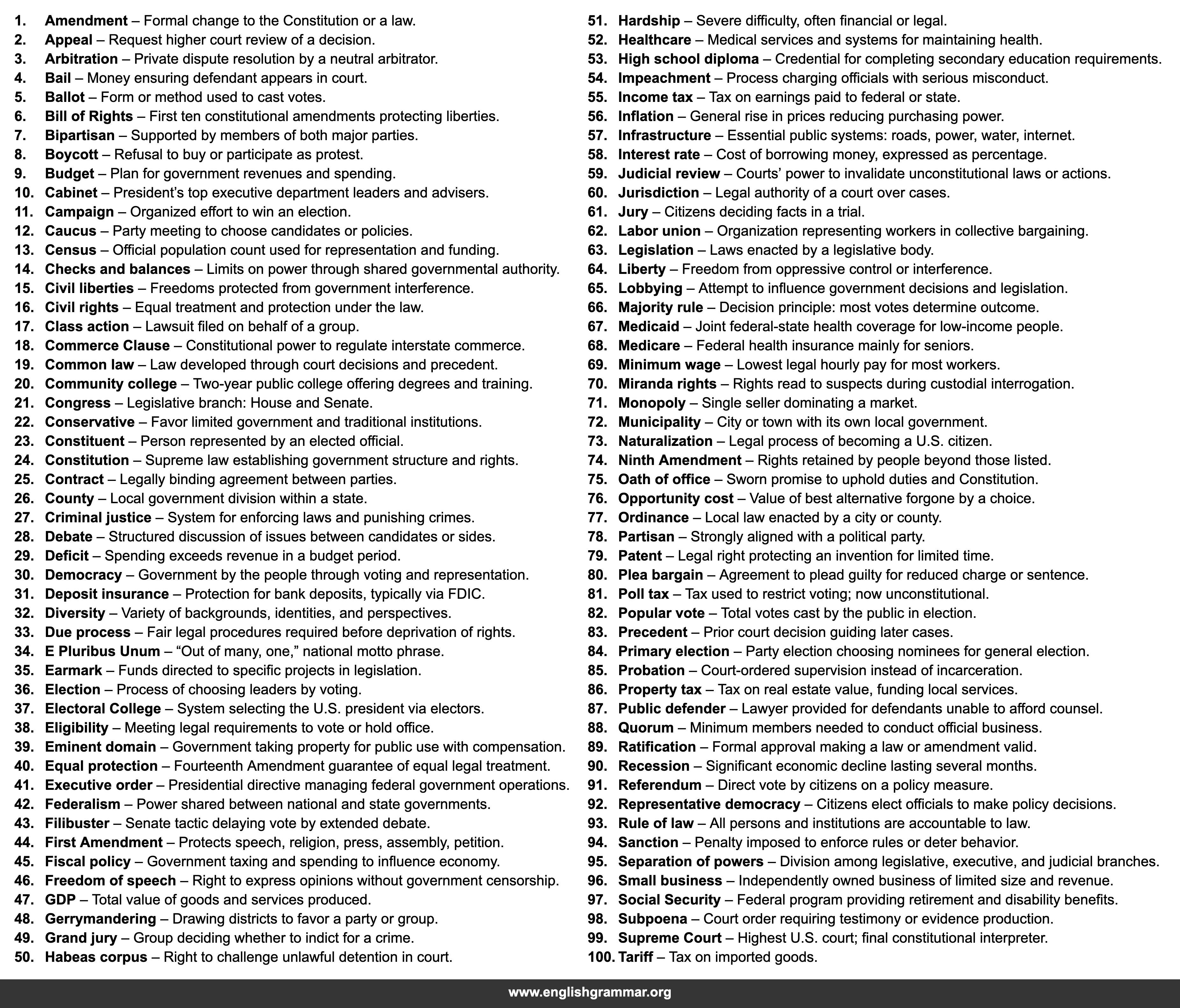
100 Words Every American Should Know

January 17, 2026

No. Term Definition
1. Amendment Formal change to the Constitution or a law.
2. Appeal Request higher court review of a decision.
3. Arbitration Private dispute resolution by a neutral arbitrator.
4. Bail Money ensuring defendant appears in court.
5. Ballot Form or method used to cast votes.
6. Bill of Rights First ten constitutional amendments protecting liberties.
7. Bipartisan Supported by members of both major parties.
8. Boycott Refusal to buy or participate as protest.
9. Budget Plan for government revenues and spending.
10. Cabinet President’s top executive department leaders and advisers.
11. Campaign Organized effort to win an election.
12. Caucus Party meeting to choose candidates or policies.
13. Census Official population count used for representation and funding.
14. Checks and balances Limits on power through shared governmental authority.
15. Civil liberties Freedoms protected from government interference.
16. Civil rights Equal treatment and protection under the law.
17. Class action Lawsuit filed on behalf of a group.
18. Commerce Clause Constitutional power to regulate interstate commerce.
19. Common law Law developed through court decisions and precedent.
20. Community college Two-year public college offering degrees and training.
21. Congress Legislative branch: House and Senate.
22. Conservative Favor limited government and traditional institutions.
23. Constituent Person represented by an elected official.
24. Constitution Supreme law establishing government structure and rights.
25. Contract Legally binding agreement between parties.
26. County Local government division within a state.
27. Criminal justice System for enforcing laws and punishing crimes.
28. Debate Structured discussion of issues between candidates or sides.
29. Deficit Spending exceeds revenue in a budget period.
30. Democracy Government by the people through voting and representation.
31. Deposit insurance Protection for bank deposits, typically via FDIC.
32. Diversity Variety of backgrounds, identities, and perspectives.
33. Due process Fair legal procedures required before deprivation of rights.
34. E Pluribus Unum “Out of many, one,” national motto phrase.
35. Earmark Funds directed to specific projects in legislation.
36. Election Process of choosing leaders by voting.
37. Electoral College System selecting the U.S. president via electors.
38. Eligibility Meeting legal requirements to vote or hold office.
39. Eminent domain Government taking property for public use with compensation.
40. Equal protection Fourteenth Amendment guarantee of equal legal treatment.
41. Executive order Presidential directive managing federal government operations.
42. Federalism Power shared between national and state governments.
43. Filibuster Senate tactic delaying vote by extended debate.
44. First Amendment Protects speech, religion, press, assembly, petition.
45. Fiscal policy Government taxing and spending to influence economy.
46. Freedom of speech Right to express opinions without government censorship.
47. GDP Total value of goods and services produced.
48. Gerrymandering Drawing districts to favor a party or group.
49. Grand jury Group deciding whether to indict for a crime.
50. Habeas corpus Right to challenge unlawful detention in court.
51. Hardship Severe difficulty, often financial or legal.
52. Healthcare Medical services and systems for maintaining health.
53. High school diploma Credential for completing secondary education requirements.
54. Impeachment Process charging officials with serious misconduct.
55. Income tax Tax on earnings paid to federal or state.
56. Inflation General rise in prices reducing purchasing power.
57. Infrastructure Essential public systems: roads, power, water, internet.
58. Interest rate Cost of borrowing money, expressed as percentage.
59. Judicial review Courts’ power to invalidate unconstitutional laws or actions.
60. Jurisdiction Legal authority of a court over cases.
61. Jury Citizens deciding facts in a trial.
62. Labor union Organization representing workers in collective bargaining.
63. Legislation Laws enacted by a legislative body.
64. Liberty Freedom from oppressive control or interference.
65. Lobbying Attempt to influence government decisions and legislation.
66. Majority rule Decision principle: most votes determine outcome.
67. Medicaid Joint federal-state health coverage for low-income people.
68. Medicare Federal health insurance mainly for seniors.
69. Minimum wage Lowest legal hourly pay for most workers.
70. Miranda rights Rights read to suspects during custodial interrogation.
71. Monopoly Single seller dominating a market.
72. Municipality City or town with its own local government.
73. Naturalization Legal process of becoming a U.S. citizen.
74. Ninth Amendment Rights retained by people beyond those listed.
75. Oath of office Sworn promise to uphold duties and Constitution.
76. Opportunity cost Value of best alternative forgone by a choice.
77. Ordinance Local law enacted by a city or county.
78. Partisan Strongly aligned with a political party.
79. Patent Legal right protecting an invention for limited time.
80. Plea bargain Agreement to plead guilty for reduced charge or sentence.
81. Poll tax Tax used to restrict voting; now unconstitutional.
82. Popular vote Total votes cast by the public in election.
83. Precedent Prior court decision guiding later cases.
84. Primary election Party election choosing nominees for general election.
85. Probation Court-ordered supervision instead of incarceration.
86. Property tax Tax on real estate value, funding local services.
87. Public defender Lawyer provided for defendants unable to afford counsel.
88. Quorum Minimum members needed to conduct official business.
89. Ratification Formal approval making a law or amendment valid.
90. Recession Significant economic decline lasting several months.
91. Referendum Direct vote by citizens on a policy measure.
92. Representative democracy Citizens elect officials to make policy decisions.
93. Rule of law All persons and institutions are accountable to law.
94. Sanction Penalty imposed to enforce rules or deter behavior.
95. Separation of powers Division among legislative, executive, and judicial branches.
96. Small business Independently owned business of limited size and revenue.
97. Social Security Federal program providing retirement and disability benefits.
98. Subpoena Court order requiring testimony or evidence production.
99. Supreme Court Highest U.S. court; final constitutional interpreter.
100. Tariff Tax on imported goods.

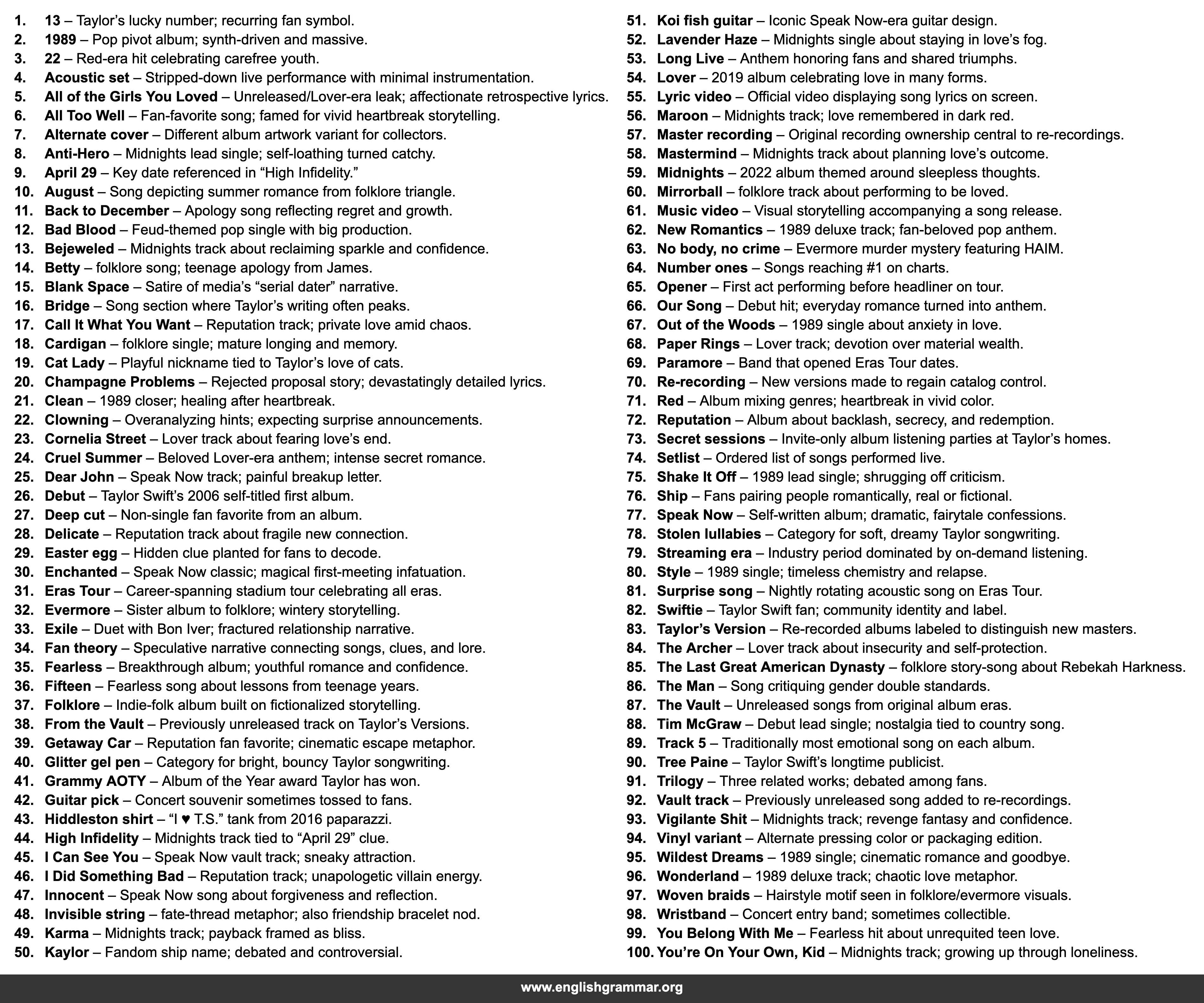
100 Words Every Taylor Swift Fan Should Know

January 17, 2026

No. Term Definition
1. 13 Taylor’s lucky number; recurring fan symbol.
2. 1989 Pop pivot album; synth-driven and massive.
3. 22 Red-era hit celebrating carefree youth.
4. Acoustic set Stripped-down live performance with minimal instrumentation.
5. All of the Girls You Loved Unreleased/Lover-era leak; affectionate retrospective lyrics.
6. All Too Well Fan-favorite song; famed for vivid heartbreak storytelling.
7. Alternate cover Different album artwork variant for collectors.
8. Anti-Hero Midnights lead single; self-loathing turned catchy.
9. April 29 Key date referenced in “High Infidelity.”
10. August Song depicting summer romance from folklore triangle.
11. Back to December Apology song reflecting regret and growth.
12. Bad Blood Feud-themed pop single with big production.
13. Bejeweled Midnights track about reclaiming sparkle and confidence.
14. Betty folklore song; teenage apology from James.
15. Blank Space Satire of media’s “serial dater” narrative.
16. Bridge Song section where Taylor’s writing often peaks.
17. Call It What You Want Reputation track; private love amid chaos.
18. Cardigan folklore single; mature longing and memory.
19. Cat Lady Playful nickname tied to Taylor’s love of cats.
20. Champagne Problems Rejected proposal story; devastatingly detailed lyrics.
21. Clean 1989 closer; healing after heartbreak.
22. Clowning Overanalyzing hints; expecting surprise announcements.
23. Cornelia Street Lover track about fearing love’s end.
24. Cruel Summer Beloved Lover-era anthem; intense secret romance.
25. Dear John Speak Now track; painful breakup letter.
26. Debut Taylor Swift’s 2006 self-titled first album.
27. Deep cut Non-single fan favorite from an album.
28. Delicate Reputation track about fragile new connection.
29. Easter egg Hidden clue planted for fans to decode.
30. Enchanted Speak Now classic; magical first-meeting infatuation.
31. Eras Tour Career-spanning stadium tour celebrating all eras.
32. Evermore Sister album to folklore; wintery storytelling.
33. Exile Duet with Bon Iver; fractured relationship narrative.
34. Fan theory Speculative narrative connecting songs, clues, and lore.
35. Fearless Breakthrough album; youthful romance and confidence.
36. Fifteen Fearless song about lessons from teenage years.
37. Folklore Indie-folk album built on fictionalized storytelling.
38. From the Vault Previously unreleased track on Taylor’s Versions.
39. Getaway Car Reputation fan favorite; cinematic escape metaphor.
40. Glitter gel pen Category for bright, bouncy Taylor songwriting.
41. Grammy AOTY Album of the Year award Taylor has won.
42. Guitar pick Concert souvenir sometimes tossed to fans.
43. Hiddleston shirt “I ♥ T.S.” tank from 2016 paparazzi.
44. High Infidelity Midnights track tied to “April 29” clue.
45. I Can See You Speak Now vault track; sneaky attraction.
46. I Did Something Bad Reputation track; unapologetic villain energy.
47. Innocent Speak Now song about forgiveness and reflection.
48. Invisible string fate-thread metaphor; also friendship bracelet nod.
49. Karma Midnights track; payback framed as bliss.
50. Kaylor Fandom ship name; debated and controversial.
51. Koi fish guitar Iconic Speak Now-era guitar design.
52. Lavender Haze Midnights single about staying in love’s fog.
53. Long Live Anthem honoring fans and shared triumphs.
54. Lover 2019 album celebrating love in many forms.
55. Lyric video Official video displaying song lyrics on screen.
56. Maroon Midnights track; love remembered in dark red.
57. Master recording Original recording ownership central to re-recordings.
58. Mastermind Midnights track about planning love’s outcome.
59. Midnights 2022 album themed around sleepless thoughts.
60. Mirrorball folklore track about performing to be loved.
61. Music video Visual storytelling accompanying a song release.
62. New Romantics 1989 deluxe track; fan-beloved pop anthem.
63. No body, no crime Evermore murder mystery featuring HAIM.
64. Number ones Songs reaching #1 on charts.
65. Opener First act performing before headliner on tour.
66. Our Song Debut hit; everyday romance turned into anthem.
67. Out of the Woods 1989 single about anxiety in love.
68. Paper Rings Lover track; devotion over material wealth.
69. Paramore Band that opened Eras Tour dates.
70. Re-recording New versions made to regain catalog control.
71. Red Album mixing genres; heartbreak in vivid color.
72. Reputation Album about backlash, secrecy, and redemption.
73. Secret sessions Invite-only album listening parties at Taylor’s homes.
74. Setlist Ordered list of songs performed live.
75. Shake It Off 1989 lead single; shrugging off criticism.
76. Ship Fans pairing people romantically, real or fictional.
77. Speak Now Self-written album; dramatic, fairytale confessions.
78. Stolen lullabies Category for soft, dreamy Taylor songwriting.
79. Streaming era Industry period dominated by on-demand listening.
80. Style 1989 single; timeless chemistry and relapse.
81. Surprise song Nightly rotating acoustic song on Eras Tour.
82. Swiftie Taylor Swift fan; community identity and label.
83. Taylor’s Version Re-recorded albums labeled to distinguish new masters.
84. The Archer Lover track about insecurity and self-protection.
85. The Last Great American Dynasty folklore story-song about Rebekah Harkness.
86. The Man Song critiquing gender double standards.
87. The Vault Unreleased songs from original album eras.
88. Tim McGraw Debut lead single; nostalgia tied to country song.
89. Track 5 Traditionally most emotional song on each album.
90. Tree Paine Taylor Swift’s longtime publicist.
91. Trilogy Three related works; debated among fans.
92. Vault track Previously unreleased song added to re-recordings.
93. Vigilante Shit Midnights track; revenge fantasy and confidence.
94. Vinyl variant Alternate pressing color or packaging edition.
95. Wildest Dreams 1989 single; cinematic romance and goodbye.
96. Wonderland 1989 deluxe track; chaotic love metaphor.
97. Woven braids Hairstyle motif seen in folklore/evermore visuals.
98. Wristband Concert entry band; sometimes collectible.
99. You Belong With Me Fearless hit about unrequited teen love.
100. You’re On Your Own, Kid Midnights track; growing up through loneliness.

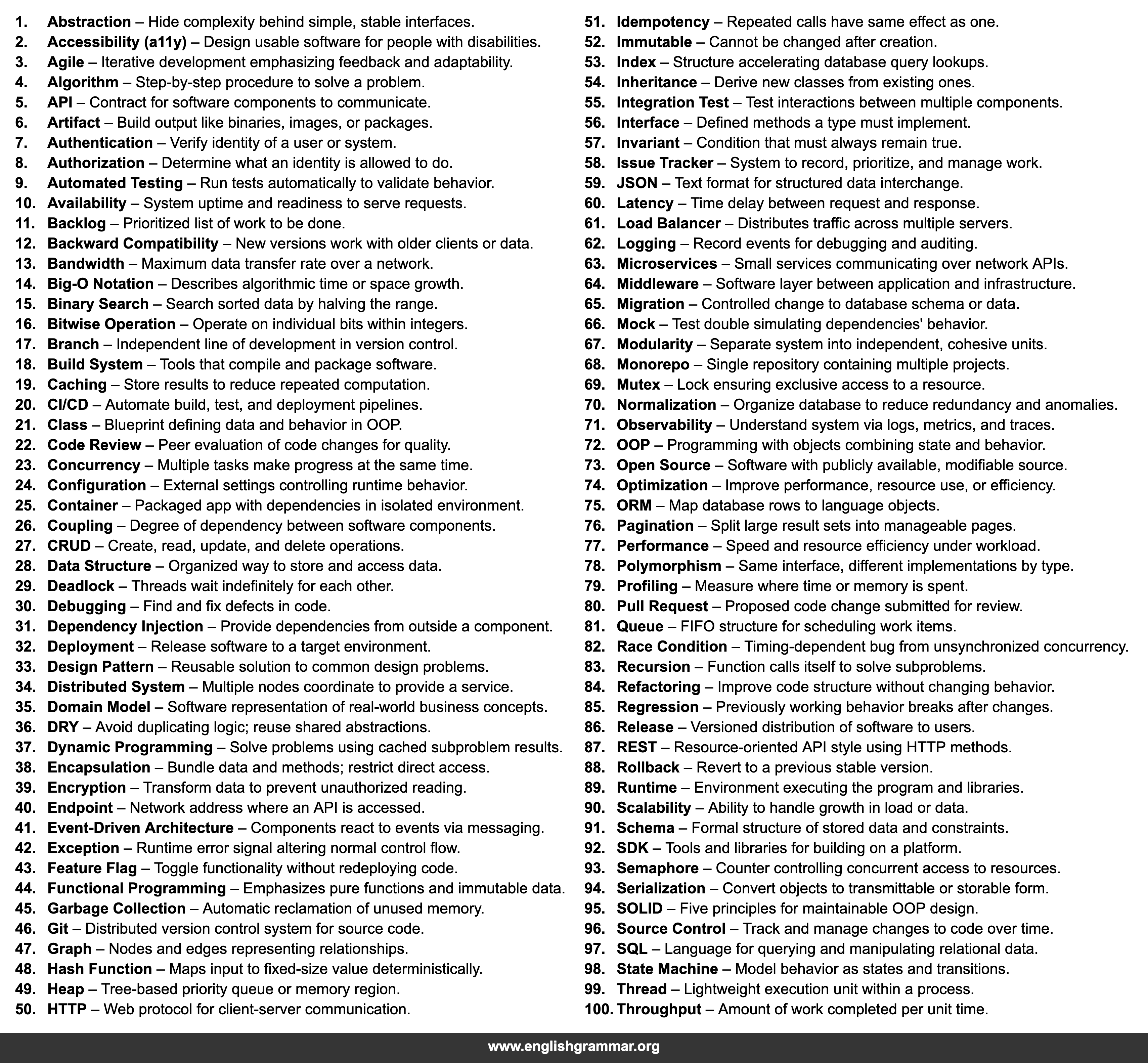
100 Terms Every Software Developer Should Know

January 17, 2026

No. Term Definition
1. Abstraction Hide complexity behind simple, stable interfaces.
2. Accessibility (a11y) Design usable software for people with disabilities.
3. Agile Iterative development emphasizing feedback and adaptability.
4. Algorithm Step-by-step procedure to solve a problem.
5. API Contract for software components to communicate.
6. Artifact Build output like binaries, images, or packages.
7. Authentication Verify identity of a user or system.
8. Authorization Determine what an identity is allowed to do.
9. Automated Testing Run tests automatically to validate behavior.
10. Availability System uptime and readiness to serve requests.
11. Backlog Prioritized list of work to be done.
12. Backward Compatibility New versions work with older clients or data.
13. Bandwidth Maximum data transfer rate over a network.
14. Big-O Notation Describes algorithmic time or space growth.
15. Binary Search Search sorted data by halving the range.
16. Bitwise Operation Operate on individual bits within integers.
17. Branch Independent line of development in version control.
18. Build System Tools that compile and package software.
19. Caching Store results to reduce repeated computation.
20. CI/CD Automate build, test, and deployment pipelines.
21. Class Blueprint defining data and behavior in OOP.
22. Code Review Peer evaluation of code changes for quality.
23. Concurrency Multiple tasks make progress at the same time.
24. Configuration External settings controlling runtime behavior.
25. Container Packaged app with dependencies in isolated environment.
26. Coupling Degree of dependency between software components.
27. CRUD Create, read, update, and delete operations.
28. Data Structure Organized way to store and access data.
29. Deadlock Threads wait indefinitely for each other.
30. Debugging Find and fix defects in code.
31. Dependency Injection Provide dependencies from outside a component.
32. Deployment Release software to a target environment.
33. Design Pattern Reusable solution to common design problems.
34. Distributed System Multiple nodes coordinate to provide a service.
35. Domain Model Software representation of real-world business concepts.
36. DRY Avoid duplicating logic; reuse shared abstractions.
37. Dynamic Programming Solve problems using cached subproblem results.
38. Encapsulation Bundle data and methods; restrict direct access.
39. Encryption Transform data to prevent unauthorized reading.
40. Endpoint Network address where an API is accessed.
41. Event-Driven Architecture Components react to events via messaging.
42. Exception Runtime error signal altering normal control flow.
43. Feature Flag Toggle functionality without redeploying code.
44. Functional Programming Emphasizes pure functions and immutable data.
45. Garbage Collection Automatic reclamation of unused memory.
46. Git Distributed version control system for source code.
47. Graph Nodes and edges representing relationships.
48. Hash Function Maps input to fixed-size value deterministically.
49. Heap Tree-based priority queue or memory region.
50. HTTP Web protocol for client-server communication.
51. Idempotency Repeated calls have same effect as one.
52. Immutable Cannot be changed after creation.
53. Index Structure accelerating database query lookups.
54. Inheritance Derive new classes from existing ones.
55. Integration Test Test interactions between multiple components.
56. Interface Defined methods a type must implement.
57. Invariant Condition that must always remain true.
58. Issue Tracker System to record, prioritize, and manage work.
59. JSON Text format for structured data interchange.
60. Latency Time delay between request and response.
61. Load Balancer Distributes traffic across multiple servers.
62. Logging Record events for debugging and auditing.
63. Microservices Small services communicating over network APIs.
64. Middleware Software layer between application and infrastructure.
65. Migration Controlled change to database schema or data.
66. Mock Test double simulating dependencies’ behavior.
67. Modularity Separate system into independent, cohesive units.
68. Monorepo Single repository containing multiple projects.
69. Mutex Lock ensuring exclusive access to a resource.
70. Normalization Organize database to reduce redundancy and anomalies.
71. Observability Understand system via logs, metrics, and traces.
72. OOP Programming with objects combining state and behavior.
73. Open Source Software with publicly available, modifiable source.
74. Optimization Improve performance, resource use, or efficiency.
75. ORM Map database rows to language objects.
76. Pagination Split large result sets into manageable pages.
77. Performance Speed and resource efficiency under workload.
78. Polymorphism Same interface, different implementations by type.
79. Profiling Measure where time or memory is spent.
80. Pull Request Proposed code change submitted for review.
81. Queue FIFO structure for scheduling work items.
82. Race Condition Timing-dependent bug from unsynchronized concurrency.
83. Recursion Function calls itself to solve subproblems.
84. Refactoring Improve code structure without changing behavior.
85. Regression Previously working behavior breaks after changes.
86. Release Versioned distribution of software to users.
87. REST Resource-oriented API style using HTTP methods.
88. Rollback Revert to a previous stable version.
89. Runtime Environment executing the program and libraries.
90. Scalability Ability to handle growth in load or data.
91. Schema Formal structure of stored data and constraints.
92. SDK Tools and libraries for building on a platform.
93. Semaphore Counter controlling concurrent access to resources.
94. Serialization Convert objects to transmittable or storable form.
95. SOLID Five principles for maintainable OOP design.
96. Source Control Track and manage changes to code over time.
97. SQL Language for querying and manipulating relational data.
98. State Machine Model behavior as states and transitions.
99. Thread Lightweight execution unit within a process.
100. Throughput Amount of work completed per unit time.
  • « Go to Previous Page
  • Page 1
  • Interim pages omitted …
  • Page 1034
  • Page 1035
  • Page 1036
  • Page 1037
  • Page 1038
  • Interim pages omitted …
  • Page 1042
  • Go to Next Page »

Primary Sidebar

2,485,429 
761,532 
Improve Your English
  • Download 2026 Grammar Guide (PDF)
  • Free Weekly Exercises & Vocabulary
  • Join over 3 Million English Learners
We respect your privacy. Unsubscribe anytime.
Grammar Checker - Try Now

Latest Posts

  • Appointments Vocabulary Exercise October 12, 2026
  • 100 Best Synonyms for “Provoked” October 12, 2026
  • 100 Best Synonyms for “Stranded” October 12, 2026
  • The surprisingly old roots of “newfangled” October 12, 2026
  • 100 Best Synonyms for “Answer” October 12, 2026
  • 100 Best Synonyms for “Prove” October 12, 2026
  • 100 Best Synonyms for “Repressed” October 12, 2026
  • 100 Best Synonyms for “Ambiguity” October 12, 2026
  • 100 Best Synonyms for “Paradigmatic” October 12, 2026
  • 100 Best Synonyms for “Propaganda” October 12, 2026
Home of English Grammar

Free English grammar exercises, rules and vocabulary lists, with new exercises every week. Join the leading English grammar site with over 3 million followers.

Pro

Learn

  • Exercises
  • Matches
  • Grammar rules
  • Vocabulary lists
  • Writing guides
  • Online tools

More

  • Top social media posts
  • Various posts
  • Free grammar guide (PDF)
  • Contact

Pro

  • What is Pro?
  • Pro account
  • Pro exercises

Copyright © 2026 EnglishGrammar.org

  • Disclaimer
  • Privacy policy
  • Refund policy
  • Terms
  • Sitemap
Improve Your English
  • Download 2026 Grammar Guide (PDF)
  • Free Weekly Exercises & Vocabulary
  • Join over 3 Million English Learners
We respect your privacy. Unsubscribe anytime.