| No. | Term | Definition |
|---|---|---|
| 1. | Action item | Specific task assigned with owner and due date. |
| 2. | Agenda | Planned list of meeting topics in order. |
| 3. | Alignment | Shared understanding of goals, priorities, and approach. |
| 4. | Annual review | Yearly performance evaluation and development discussion. |
| 5. | Asynchronous | Not happening at the same time; delayed responses. |
| 6. | Bandwidth | Available time and capacity to do work. |
| 7. | Benchmark | Standard used to compare performance or quality. |
| 8. | Best practice | Proven method generally producing superior results. |
| 9. | Blocker | Issue preventing progress on a task. |
| 10. | Board meeting | Formal meeting of directors for governance decisions. |
| 11. | Brainstorming | Generating many ideas quickly without immediate judgment. |
| 12. | Budget | Planned allocation of money for a period. |
| 13. | Business case | Justification outlining benefits, costs, and risks. |
| 14. | Calendar invite | Meeting request sent through a scheduling tool. |
| 15. | Capacity planning | Forecasting resources needed to meet expected demand. |
| 16. | Change management | Process to adopt new systems or ways of working. |
| 17. | Client | Customer receiving services or deliverables from you. |
| 18. | Compliance | Following laws, regulations, and internal policies. |
| 19. | Confidentiality | Keeping sensitive information private and protected. |
| 20. | Conflict of interest | Personal interest that could bias professional decisions. |
| 21. | Consensus | General agreement acceptable to all participants. |
| 22. | Contract | Legally binding agreement defining obligations and terms. |
| 23. | Core hours | Time window when everyone is expected available. |
| 24. | Cost center | Department tracked for expenses, not direct revenue. |
| 25. | Cross-functional | Involving multiple departments or specialties working together. |
| 26. | Daily stand-up | Brief daily check-in on progress and obstacles. |
| 27. | Dashboard | Visual summary of key metrics and status. |
| 28. | Data privacy | Protecting personal data from misuse or exposure. |
| 29. | Deadline | Latest date or time a task is due. |
| 30. | Decision log | Record of decisions, rationale, and responsible parties. |
| 31. | Delegation | Assigning tasks and authority to others. |
| 32. | Deliverable | Tangible output produced for a project or client. |
| 33. | Dependencies | Tasks or conditions required before work can proceed. |
| 34. | Discovery | Early phase to understand needs and constraints. |
| 35. | Documentation | Written records explaining processes, decisions, and instructions. |
| 36. | Due diligence | Careful investigation before committing to a decision. |
| 37. | Efficiency | Achieving results with minimal waste of resources. |
| 38. | Email etiquette | Professional norms for clear, respectful email communication. |
| 39. | Escalation | Raising an issue to higher authority for resolution. |
| 40. | ETA | Estimated time when something will be completed. |
| 41. | Executive summary | Brief overview of key points and recommendations. |
| 42. | Feedback | Information to improve performance, behavior, or output. |
| 43. | Fiscal year | Twelve-month accounting period for financial reporting. |
| 44. | Follow-up | Next communication to confirm actions or progress. |
| 45. | Forecast | Prediction of future performance, demand, or results. |
| 46. | Governance | Structures and rules for oversight and decision-making. |
| 47. | Hand-off | Transfer of responsibility between people or teams. |
| 48. | Headcount | Number of employees in a team or company. |
| 49. | Hybrid work | Mix of remote and in-office working arrangements. |
| 50. | Inbox zero | Method aiming to keep email inbox empty. |
| 51. | Incident | Unplanned event disrupting normal operations or service. |
| 52. | Inclusion | Ensuring people feel valued and able to contribute. |
| 53. | Initiative | Planned effort to achieve a specific improvement. |
| 54. | Internal stakeholder | Employee or team affected by your work. |
| 55. | Knowledge base | Central repository of helpful articles and answers. |
| 56. | KPI | Key metric tracking progress toward a goal. |
| 57. | Lead time | Time from request to delivery completion. |
| 58. | Lean | Approach focused on reducing waste and improving flow. |
| 59. | Lessons learned | Documented insights from successes and failures. |
| 60. | Meeting minutes | Written record of meeting decisions and actions. |
| 61. | Milestone | Significant checkpoint marking progress in a project. |
| 62. | Mission statement | Short description of an organization’s purpose. |
| 63. | MoM | Minutes of meeting; summary of discussion and actions. |
| 64. | Morale | Overall confidence, enthusiasm, and satisfaction at work. |
| 65. | Net profit | Earnings after all expenses, taxes, and costs. |
| 66. | Non-disclosure agreement | Contract preventing sharing of confidential information. |
| 67. | OKR | Goals framework: objectives with measurable key results. |
| 68. | Onboarding | Process of integrating and training a new employee. |
| 69. | One-on-one | Private meeting between manager and employee. |
| 70. | Operating expense | Ongoing cost to run day-to-day operations. |
| 71. | Org chart | Diagram showing reporting lines and team structure. |
| 72. | Out of office | Automatic reply indicating unavailability and return date. |
| 73. | Ownership | Taking responsibility for results and follow-through. |
| 74. | Performance plan | Documented steps and goals to improve performance. |
| 75. | Pipeline | Sequence of work items moving toward completion. |
| 76. | Policy | Formal rule guiding decisions and acceptable behavior. |
| 77. | Prioritization | Ordering tasks by importance and urgency. |
| 78. | Process | Repeatable steps to produce consistent outcomes. |
| 79. | Project charter | Document defining scope, objectives, and authority. |
| 80. | Project scope | Boundaries of what a project will deliver. |
| 81. | Proposal | Suggested plan offered for approval or selection. |
| 82. | Quarterly review | Three-month performance and results check-in. |
| 83. | RACI | Roles matrix: responsible, accountable, consulted, informed. |
| 84. | Remote work | Working from outside the office using digital tools. |
| 85. | Reporting line | Who you report to in the organization. |
| 86. | Resource allocation | Assigning people, time, and budget to tasks. |
| 87. | Retrospective | Team reflection to improve after a work cycle. |
| 88. | Risk register | List of risks with impact, likelihood, and mitigations. |
| 89. | Roadmap | Planned timeline of initiatives and deliverables. |
| 90. | ROI | Return compared to cost of an investment. |
| 91. | SLA | Service agreement defining response and resolution targets. |
| 92. | Stakeholder | Person affected by or influencing a project. |
| 93. | Status update | Brief report on progress, risks, and next steps. |
| 94. | Strategic plan | Long-term goals and actions to achieve them. |
| 95. | Synergy | Combined effort producing greater results than separately. |
| 96. | Team charter | Agreement on team purpose, norms, and roles. |
| 97. | Timeline | Schedule of tasks and milestones over time. |
| 98. | Touch base | Briefly connect to share updates or align. |
| 99. | Training | Learning activities to build job-related skills. |
| 100. | Turnaround time | Time taken to complete and return a request. |
Vocabulary
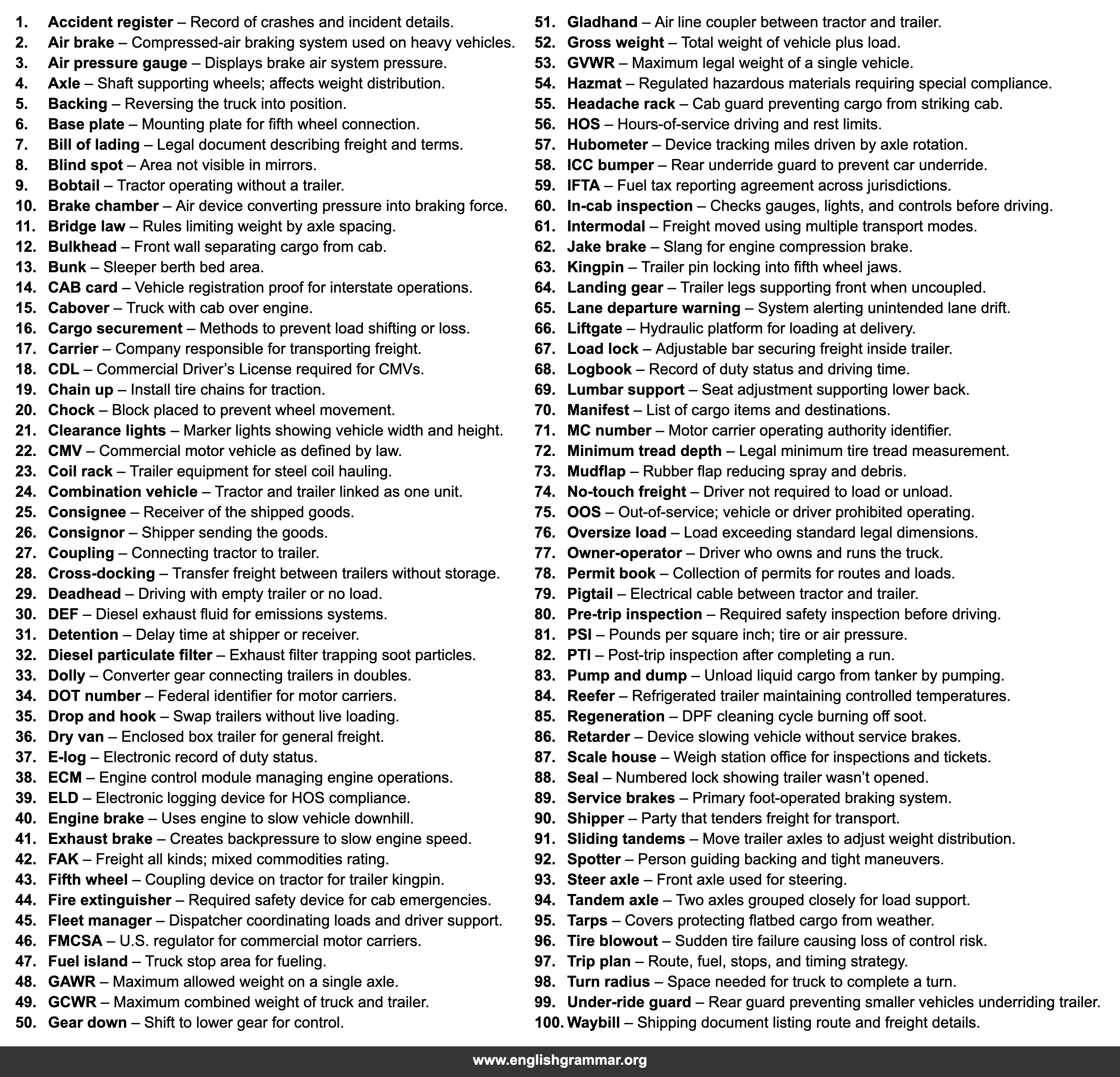
100 Terms Every Truck Driver Should Know
| No. | Term | Definition |
|---|---|---|
| 1. | Accident register | Record of crashes and incident details. |
| 2. | Air brake | Compressed-air braking system used on heavy vehicles. |
| 3. | Air pressure gauge | Displays brake air system pressure. |
| 4. | Axle | Shaft supporting wheels; affects weight distribution. |
| 5. | Backing | Reversing the truck into position. |
| 6. | Base plate | Mounting plate for fifth wheel connection. |
| 7. | Bill of lading | Legal document describing freight and terms. |
| 8. | Blind spot | Area not visible in mirrors. |
| 9. | Bobtail | Tractor operating without a trailer. |
| 10. | Brake chamber | Air device converting pressure into braking force. |
| 11. | Bridge law | Rules limiting weight by axle spacing. |
| 12. | Bulkhead | Front wall separating cargo from cab. |
| 13. | Bunk | Sleeper berth bed area. |
| 14. | CAB card | Vehicle registration proof for interstate operations. |
| 15. | Cabover | Truck with cab over engine. |
| 16. | Cargo securement | Methods to prevent load shifting or loss. |
| 17. | Carrier | Company responsible for transporting freight. |
| 18. | CDL | Commercial Driver’s License required for CMVs. |
| 19. | Chain up | Install tire chains for traction. |
| 20. | Chock | Block placed to prevent wheel movement. |
| 21. | Clearance lights | Marker lights showing vehicle width and height. |
| 22. | CMV | Commercial motor vehicle as defined by law. |
| 23. | Coil rack | Trailer equipment for steel coil hauling. |
| 24. | Combination vehicle | Tractor and trailer linked as one unit. |
| 25. | Consignee | Receiver of the shipped goods. |
| 26. | Consignor | Shipper sending the goods. |
| 27. | Coupling | Connecting tractor to trailer. |
| 28. | Cross-docking | Transfer freight between trailers without storage. |
| 29. | Deadhead | Driving with empty trailer or no load. |
| 30. | DEF | Diesel exhaust fluid for emissions systems. |
| 31. | Detention | Delay time at shipper or receiver. |
| 32. | Diesel particulate filter | Exhaust filter trapping soot particles. |
| 33. | Dolly | Converter gear connecting trailers in doubles. |
| 34. | DOT number | Federal identifier for motor carriers. |
| 35. | Drop and hook | Swap trailers without live loading. |
| 36. | Dry van | Enclosed box trailer for general freight. |
| 37. | E-log | Electronic record of duty status. |
| 38. | ECM | Engine control module managing engine operations. |
| 39. | ELD | Electronic logging device for HOS compliance. |
| 40. | Engine brake | Uses engine to slow vehicle downhill. |
| 41. | Exhaust brake | Creates backpressure to slow engine speed. |
| 42. | FAK | Freight all kinds; mixed commodities rating. |
| 43. | Fifth wheel | Coupling device on tractor for trailer kingpin. |
| 44. | Fire extinguisher | Required safety device for cab emergencies. |
| 45. | Fleet manager | Dispatcher coordinating loads and driver support. |
| 46. | FMCSA | U.S. regulator for commercial motor carriers. |
| 47. | Fuel island | Truck stop area for fueling. |
| 48. | GAWR | Maximum allowed weight on a single axle. |
| 49. | GCWR | Maximum combined weight of truck and trailer. |
| 50. | Gear down | Shift to lower gear for control. |
| 51. | Gladhand | Air line coupler between tractor and trailer. |
| 52. | Gross weight | Total weight of vehicle plus load. |
| 53. | GVWR | Maximum legal weight of a single vehicle. |
| 54. | Hazmat | Regulated hazardous materials requiring special compliance. |
| 55. | Headache rack | Cab guard preventing cargo from striking cab. |
| 56. | HOS | Hours-of-service driving and rest limits. |
| 57. | Hubometer | Device tracking miles driven by axle rotation. |
| 58. | ICC bumper | Rear underride guard to prevent car underride. |
| 59. | IFTA | Fuel tax reporting agreement across jurisdictions. |
| 60. | In-cab inspection | Checks gauges, lights, and controls before driving. |
| 61. | Intermodal | Freight moved using multiple transport modes. |
| 62. | Jake brake | Slang for engine compression brake. |
| 63. | Kingpin | Trailer pin locking into fifth wheel jaws. |
| 64. | Landing gear | Trailer legs supporting front when uncoupled. |
| 65. | Lane departure warning | System alerting unintended lane drift. |
| 66. | Liftgate | Hydraulic platform for loading at delivery. |
| 67. | Load lock | Adjustable bar securing freight inside trailer. |
| 68. | Logbook | Record of duty status and driving time. |
| 69. | Lumbar support | Seat adjustment supporting lower back. |
| 70. | Manifest | List of cargo items and destinations. |
| 71. | MC number | Motor carrier operating authority identifier. |
| 72. | Minimum tread depth | Legal minimum tire tread measurement. |
| 73. | Mudflap | Rubber flap reducing spray and debris. |
| 74. | No-touch freight | Driver not required to load or unload. |
| 75. | OOS | Out-of-service; vehicle or driver prohibited operating. |
| 76. | Oversize load | Load exceeding standard legal dimensions. |
| 77. | Owner-operator | Driver who owns and runs the truck. |
| 78. | Permit book | Collection of permits for routes and loads. |
| 79. | Pigtail | Electrical cable between tractor and trailer. |
| 80. | Pre-trip inspection | Required safety inspection before driving. |
| 81. | PSI | Pounds per square inch; tire or air pressure. |
| 82. | PTI | Post-trip inspection after completing a run. |
| 83. | Pump and dump | Unload liquid cargo from tanker by pumping. |
| 84. | Reefer | Refrigerated trailer maintaining controlled temperatures. |
| 85. | Regeneration | DPF cleaning cycle burning off soot. |
| 86. | Retarder | Device slowing vehicle without service brakes. |
| 87. | Scale house | Weigh station office for inspections and tickets. |
| 88. | Seal | Numbered lock showing trailer wasn’t opened. |
| 89. | Service brakes | Primary foot-operated braking system. |
| 90. | Shipper | Party that tenders freight for transport. |
| 91. | Sliding tandems | Move trailer axles to adjust weight distribution. |
| 92. | Spotter | Person guiding backing and tight maneuvers. |
| 93. | Steer axle | Front axle used for steering. |
| 94. | Tandem axle | Two axles grouped closely for load support. |
| 95. | Tarps | Covers protecting flatbed cargo from weather. |
| 96. | Tire blowout | Sudden tire failure causing loss of control risk. |
| 97. | Trip plan | Route, fuel, stops, and timing strategy. |
| 98. | Turn radius | Space needed for truck to complete a turn. |
| 99. | Under-ride guard | Rear guard preventing smaller vehicles underriding trailer. |
| 100. | Waybill | Shipping document listing route and freight details. |
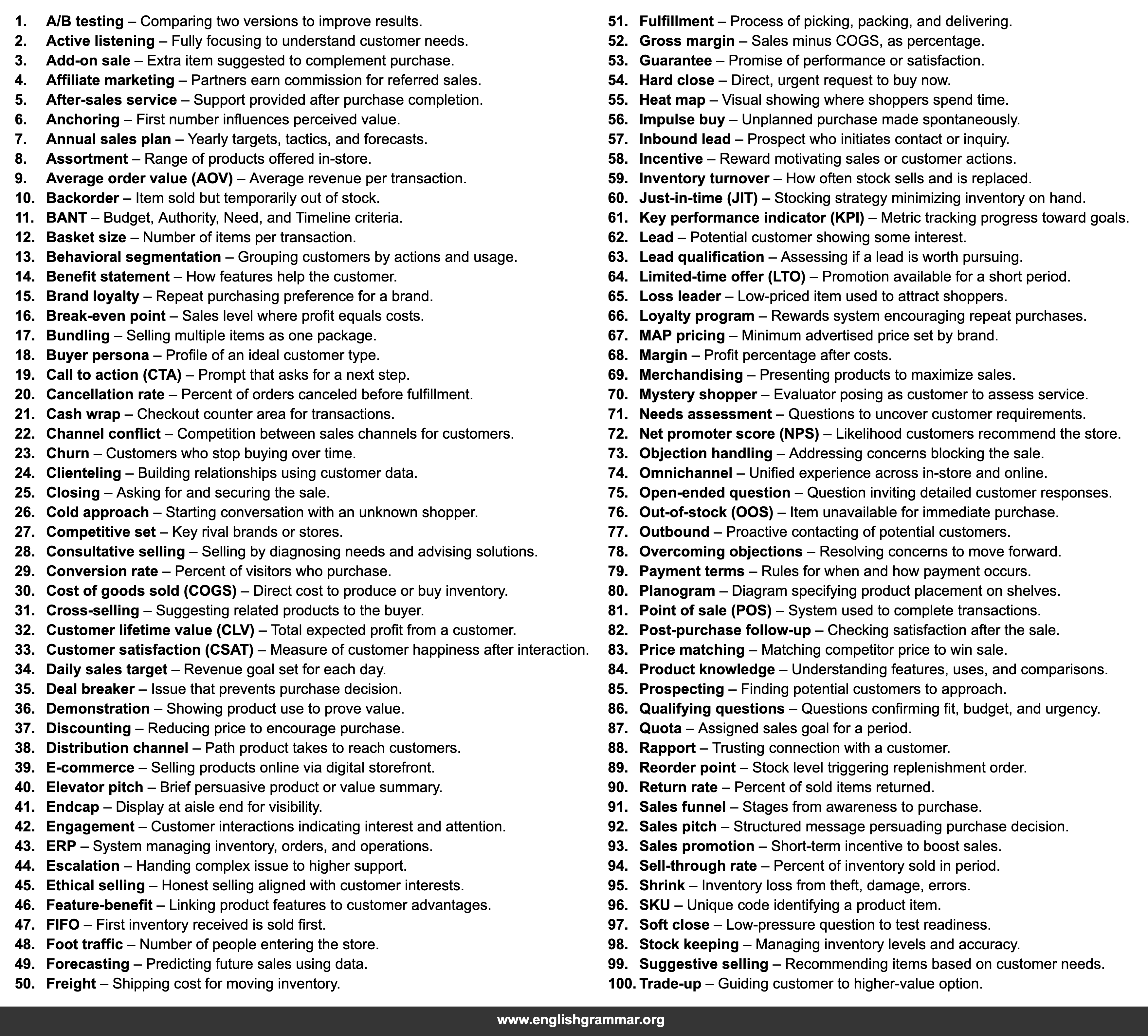
100 Terms Every Salesperson Should Know
| No. | Term | Definition |
|---|---|---|
| 1. | A/B testing | Comparing two versions to improve results. |
| 2. | Active listening | Fully focusing to understand customer needs. |
| 3. | Add-on sale | Extra item suggested to complement purchase. |
| 4. | Affiliate marketing | Partners earn commission for referred sales. |
| 5. | After-sales service | Support provided after purchase completion. |
| 6. | Anchoring | First number influences perceived value. |
| 7. | Annual sales plan | Yearly targets, tactics, and forecasts. |
| 8. | Assortment | Range of products offered in-store. |
| 9. | Average order value (AOV) | Average revenue per transaction. |
| 10. | Backorder | Item sold but temporarily out of stock. |
| 11. | BANT | Budget, Authority, Need, and Timeline criteria. |
| 12. | Basket size | Number of items per transaction. |
| 13. | Behavioral segmentation | Grouping customers by actions and usage. |
| 14. | Benefit statement | How features help the customer. |
| 15. | Brand loyalty | Repeat purchasing preference for a brand. |
| 16. | Break-even point | Sales level where profit equals costs. |
| 17. | Bundling | Selling multiple items as one package. |
| 18. | Buyer persona | Profile of an ideal customer type. |
| 19. | Call to action (CTA) | Prompt that asks for a next step. |
| 20. | Cancellation rate | Percent of orders canceled before fulfillment. |
| 21. | Cash wrap | Checkout counter area for transactions. |
| 22. | Channel conflict | Competition between sales channels for customers. |
| 23. | Churn | Customers who stop buying over time. |
| 24. | Clienteling | Building relationships using customer data. |
| 25. | Closing | Asking for and securing the sale. |
| 26. | Cold approach | Starting conversation with an unknown shopper. |
| 27. | Competitive set | Key rival brands or stores. |
| 28. | Consultative selling | Selling by diagnosing needs and advising solutions. |
| 29. | Conversion rate | Percent of visitors who purchase. |
| 30. | Cost of goods sold (COGS) | Direct cost to produce or buy inventory. |
| 31. | Cross-selling | Suggesting related products to the buyer. |
| 32. | Customer lifetime value (CLV) | Total expected profit from a customer. |
| 33. | Customer satisfaction (CSAT) | Measure of customer happiness after interaction. |
| 34. | Daily sales target | Revenue goal set for each day. |
| 35. | Deal breaker | Issue that prevents purchase decision. |
| 36. | Demonstration | Showing product use to prove value. |
| 37. | Discounting | Reducing price to encourage purchase. |
| 38. | Distribution channel | Path product takes to reach customers. |
| 39. | E-commerce | Selling products online via digital storefront. |
| 40. | Elevator pitch | Brief persuasive product or value summary. |
| 41. | Endcap | Display at aisle end for visibility. |
| 42. | Engagement | Customer interactions indicating interest and attention. |
| 43. | ERP | System managing inventory, orders, and operations. |
| 44. | Escalation | Handing complex issue to higher support. |
| 45. | Ethical selling | Honest selling aligned with customer interests. |
| 46. | Feature-benefit | Linking product features to customer advantages. |
| 47. | FIFO | First inventory received is sold first. |
| 48. | Foot traffic | Number of people entering the store. |
| 49. | Forecasting | Predicting future sales using data. |
| 50. | Freight | Shipping cost for moving inventory. |
| 51. | Fulfillment | Process of picking, packing, and delivering. |
| 52. | Gross margin | Sales minus COGS, as percentage. |
| 53. | Guarantee | Promise of performance or satisfaction. |
| 54. | Hard close | Direct, urgent request to buy now. |
| 55. | Heat map | Visual showing where shoppers spend time. |
| 56. | Impulse buy | Unplanned purchase made spontaneously. |
| 57. | Inbound lead | Prospect who initiates contact or inquiry. |
| 58. | Incentive | Reward motivating sales or customer actions. |
| 59. | Inventory turnover | How often stock sells and is replaced. |
| 60. | Just-in-time (JIT) | Stocking strategy minimizing inventory on hand. |
| 61. | Key performance indicator (KPI) | Metric tracking progress toward goals. |
| 62. | Lead | Potential customer showing some interest. |
| 63. | Lead qualification | Assessing if a lead is worth pursuing. |
| 64. | Limited-time offer (LTO) | Promotion available for a short period. |
| 65. | Loss leader | Low-priced item used to attract shoppers. |
| 66. | Loyalty program | Rewards system encouraging repeat purchases. |
| 67. | MAP pricing | Minimum advertised price set by brand. |
| 68. | Margin | Profit percentage after costs. |
| 69. | Merchandising | Presenting products to maximize sales. |
| 70. | Mystery shopper | Evaluator posing as customer to assess service. |
| 71. | Needs assessment | Questions to uncover customer requirements. |
| 72. | Net promoter score (NPS) | Likelihood customers recommend the store. |
| 73. | Objection handling | Addressing concerns blocking the sale. |
| 74. | Omnichannel | Unified experience across in-store and online. |
| 75. | Open-ended question | Question inviting detailed customer responses. |
| 76. | Out-of-stock (OOS) | Item unavailable for immediate purchase. |
| 77. | Outbound | Proactive contacting of potential customers. |
| 78. | Overcoming objections | Resolving concerns to move forward. |
| 79. | Payment terms | Rules for when and how payment occurs. |
| 80. | Planogram | Diagram specifying product placement on shelves. |
| 81. | Point of sale (POS) | System used to complete transactions. |
| 82. | Post-purchase follow-up | Checking satisfaction after the sale. |
| 83. | Price matching | Matching competitor price to win sale. |
| 84. | Product knowledge | Understanding features, uses, and comparisons. |
| 85. | Prospecting | Finding potential customers to approach. |
| 86. | Qualifying questions | Questions confirming fit, budget, and urgency. |
| 87. | Quota | Assigned sales goal for a period. |
| 88. | Rapport | Trusting connection with a customer. |
| 89. | Reorder point | Stock level triggering replenishment order. |
| 90. | Return rate | Percent of sold items returned. |
| 91. | Sales funnel | Stages from awareness to purchase. |
| 92. | Sales pitch | Structured message persuading purchase decision. |
| 93. | Sales promotion | Short-term incentive to boost sales. |
| 94. | Sell-through rate | Percent of inventory sold in period. |
| 95. | Shrink | Inventory loss from theft, damage, errors. |
| 96. | SKU | Unique code identifying a product item. |
| 97. | Soft close | Low-pressure question to test readiness. |
| 98. | Stock keeping | Managing inventory levels and accuracy. |
| 99. | Suggestive selling | Recommending items based on customer needs. |
| 100. | Trade-up | Guiding customer to higher-value option. |
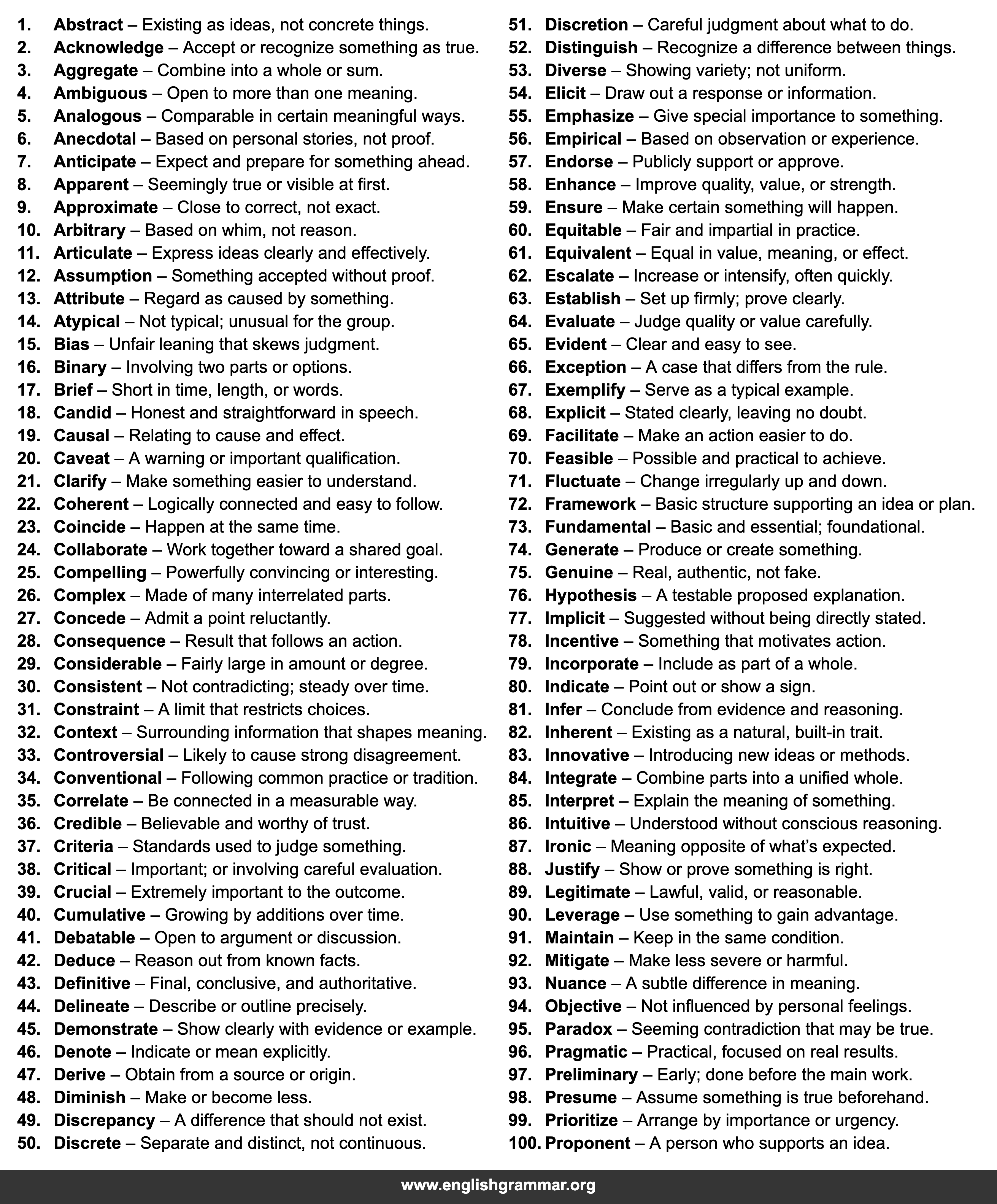
100 Words Smart People Use Without Realizing It
| No. | Term | Definition |
|---|---|---|
| 1. | Abstract | Existing as ideas, not concrete things. |
| 2. | Acknowledge | Accept or recognize something as true. |
| 3. | Aggregate | Combine into a whole or sum. |
| 4. | Ambiguous | Open to more than one meaning. |
| 5. | Analogous | Comparable in certain meaningful ways. |
| 6. | Anecdotal | Based on personal stories, not proof. |
| 7. | Anticipate | Expect and prepare for something ahead. |
| 8. | Apparent | Seemingly true or visible at first. |
| 9. | Approximate | Close to correct, not exact. |
| 10. | Arbitrary | Based on whim, not reason. |
| 11. | Articulate | Express ideas clearly and effectively. |
| 12. | Assumption | Something accepted without proof. |
| 13. | Attribute | Regard as caused by something. |
| 14. | Atypical | Not typical; unusual for the group. |
| 15. | Bias | Unfair leaning that skews judgment. |
| 16. | Binary | Involving two parts or options. |
| 17. | Brief | Short in time, length, or words. |
| 18. | Candid | Honest and straightforward in speech. |
| 19. | Causal | Relating to cause and effect. |
| 20. | Caveat | A warning or important qualification. |
| 21. | Clarify | Make something easier to understand. |
| 22. | Coherent | Logically connected and easy to follow. |
| 23. | Coincide | Happen at the same time. |
| 24. | Collaborate | Work together toward a shared goal. |
| 25. | Compelling | Powerfully convincing or interesting. |
| 26. | Complex | Made of many interrelated parts. |
| 27. | Concede | Admit a point reluctantly. |
| 28. | Consequence | Result that follows an action. |
| 29. | Considerable | Fairly large in amount or degree. |
| 30. | Consistent | Not contradicting; steady over time. |
| 31. | Constraint | A limit that restricts choices. |
| 32. | Context | Surrounding information that shapes meaning. |
| 33. | Controversial | Likely to cause strong disagreement. |
| 34. | Conventional | Following common practice or tradition. |
| 35. | Correlate | Be connected in a measurable way. |
| 36. | Credible | Believable and worthy of trust. |
| 37. | Criteria | Standards used to judge something. |
| 38. | Critical | Important; or involving careful evaluation. |
| 39. | Crucial | Extremely important to the outcome. |
| 40. | Cumulative | Growing by additions over time. |
| 41. | Debatable | Open to argument or discussion. |
| 42. | Deduce | Reason out from known facts. |
| 43. | Definitive | Final, conclusive, and authoritative. |
| 44. | Delineate | Describe or outline precisely. |
| 45. | Demonstrate | Show clearly with evidence or example. |
| 46. | Denote | Indicate or mean explicitly. |
| 47. | Derive | Obtain from a source or origin. |
| 48. | Diminish | Make or become less. |
| 49. | Discrepancy | A difference that should not exist. |
| 50. | Discrete | Separate and distinct, not continuous. |
| 51. | Discretion | Careful judgment about what to do. |
| 52. | Distinguish | Recognize a difference between things. |
| 53. | Diverse | Showing variety; not uniform. |
| 54. | Elicit | Draw out a response or information. |
| 55. | Emphasize | Give special importance to something. |
| 56. | Empirical | Based on observation or experience. |
| 57. | Endorse | Publicly support or approve. |
| 58. | Enhance | Improve quality, value, or strength. |
| 59. | Ensure | Make certain something will happen. |
| 60. | Equitable | Fair and impartial in practice. |
| 61. | Equivalent | Equal in value, meaning, or effect. |
| 62. | Escalate | Increase or intensify, often quickly. |
| 63. | Establish | Set up firmly; prove clearly. |
| 64. | Evaluate | Judge quality or value carefully. |
| 65. | Evident | Clear and easy to see. |
| 66. | Exception | A case that differs from the rule. |
| 67. | Exemplify | Serve as a typical example. |
| 68. | Explicit | Stated clearly, leaving no doubt. |
| 69. | Facilitate | Make an action easier to do. |
| 70. | Feasible | Possible and practical to achieve. |
| 71. | Fluctuate | Change irregularly up and down. |
| 72. | Framework | Basic structure supporting an idea or plan. |
| 73. | Fundamental | Basic and essential; foundational. |
| 74. | Generate | Produce or create something. |
| 75. | Genuine | Real, authentic, not fake. |
| 76. | Hypothesis | A testable proposed explanation. |
| 77. | Implicit | Suggested without being directly stated. |
| 78. | Incentive | Something that motivates action. |
| 79. | Incorporate | Include as part of a whole. |
| 80. | Indicate | Point out or show a sign. |
| 81. | Infer | Conclude from evidence and reasoning. |
| 82. | Inherent | Existing as a natural, built-in trait. |
| 83. | Innovative | Introducing new ideas or methods. |
| 84. | Integrate | Combine parts into a unified whole. |
| 85. | Interpret | Explain the meaning of something. |
| 86. | Intuitive | Understood without conscious reasoning. |
| 87. | Ironic | Meaning opposite of what’s expected. |
| 88. | Justify | Show or prove something is right. |
| 89. | Legitimate | Lawful, valid, or reasonable. |
| 90. | Leverage | Use something to gain advantage. |
| 91. | Maintain | Keep in the same condition. |
| 92. | Mitigate | Make less severe or harmful. |
| 93. | Nuance | A subtle difference in meaning. |
| 94. | Objective | Not influenced by personal feelings. |
| 95. | Paradox | Seeming contradiction that may be true. |
| 96. | Pragmatic | Practical, focused on real results. |
| 97. | Preliminary | Early; done before the main work. |
| 98. | Presume | Assume something is true beforehand. |
| 99. | Prioritize | Arrange by importance or urgency. |
| 100. | Proponent | A person who supports an idea. |
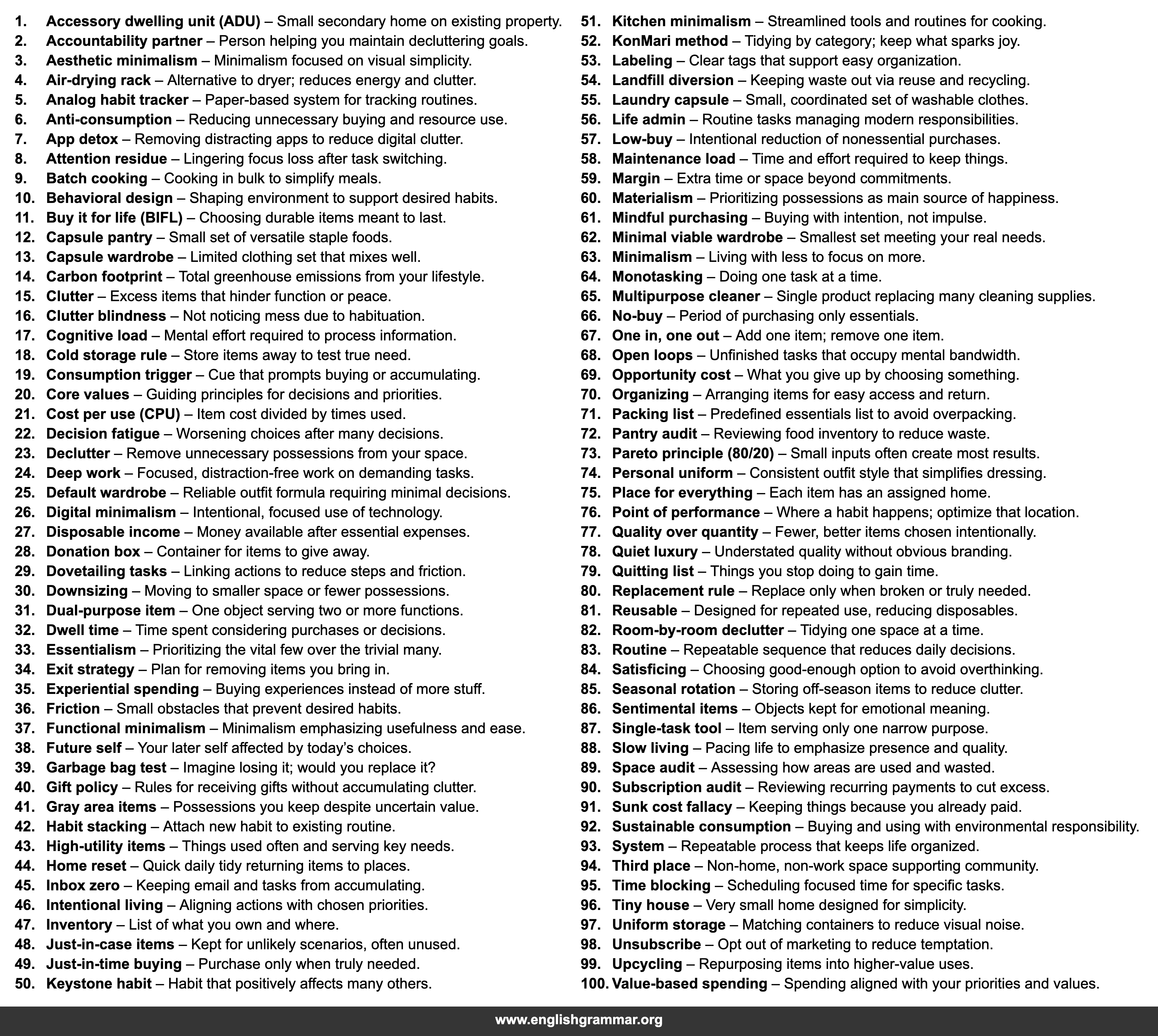
100 Terms Every Minimalist Should Know
| No. | Term | Definition |
|---|---|---|
| 1. | Accessory dwelling unit (ADU) | Small secondary home on existing property. |
| 2. | Accountability partner | Person helping you maintain decluttering goals. |
| 3. | Aesthetic minimalism | Minimalism focused on visual simplicity. |
| 4. | Air-drying rack | Alternative to dryer; reduces energy and clutter. |
| 5. | Analog habit tracker | Paper-based system for tracking routines. |
| 6. | Anti-consumption | Reducing unnecessary buying and resource use. |
| 7. | App detox | Removing distracting apps to reduce digital clutter. |
| 8. | Attention residue | Lingering focus loss after task switching. |
| 9. | Batch cooking | Cooking in bulk to simplify meals. |
| 10. | Behavioral design | Shaping environment to support desired habits. |
| 11. | Buy it for life (BIFL) | Choosing durable items meant to last. |
| 12. | Capsule pantry | Small set of versatile staple foods. |
| 13. | Capsule wardrobe | Limited clothing set that mixes well. |
| 14. | Carbon footprint | Total greenhouse emissions from your lifestyle. |
| 15. | Clutter | Excess items that hinder function or peace. |
| 16. | Clutter blindness | Not noticing mess due to habituation. |
| 17. | Cognitive load | Mental effort required to process information. |
| 18. | Cold storage rule | Store items away to test true need. |
| 19. | Consumption trigger | Cue that prompts buying or accumulating. |
| 20. | Core values | Guiding principles for decisions and priorities. |
| 21. | Cost per use (CPU) | Item cost divided by times used. |
| 22. | Decision fatigue | Worsening choices after many decisions. |
| 23. | Declutter | Remove unnecessary possessions from your space. |
| 24. | Deep work | Focused, distraction-free work on demanding tasks. |
| 25. | Default wardrobe | Reliable outfit formula requiring minimal decisions. |
| 26. | Digital minimalism | Intentional, focused use of technology. |
| 27. | Disposable income | Money available after essential expenses. |
| 28. | Donation box | Container for items to give away. |
| 29. | Dovetailing tasks | Linking actions to reduce steps and friction. |
| 30. | Downsizing | Moving to smaller space or fewer possessions. |
| 31. | Dual-purpose item | One object serving two or more functions. |
| 32. | Dwell time | Time spent considering purchases or decisions. |
| 33. | Essentialism | Prioritizing the vital few over the trivial many. |
| 34. | Exit strategy | Plan for removing items you bring in. |
| 35. | Experiential spending | Buying experiences instead of more stuff. |
| 36. | Friction | Small obstacles that prevent desired habits. |
| 37. | Functional minimalism | Minimalism emphasizing usefulness and ease. |
| 38. | Future self | Your later self affected by today’s choices. |
| 39. | Garbage bag test | Imagine losing it; would you replace it? |
| 40. | Gift policy | Rules for receiving gifts without accumulating clutter. |
| 41. | Gray area items | Possessions you keep despite uncertain value. |
| 42. | Habit stacking | Attach new habit to existing routine. |
| 43. | High-utility items | Things used often and serving key needs. |
| 44. | Home reset | Quick daily tidy returning items to places. |
| 45. | Inbox zero | Keeping email and tasks from accumulating. |
| 46. | Intentional living | Aligning actions with chosen priorities. |
| 47. | Inventory | List of what you own and where. |
| 48. | Just-in-case items | Kept for unlikely scenarios, often unused. |
| 49. | Just-in-time buying | Purchase only when truly needed. |
| 50. | Keystone habit | Habit that positively affects many others. |
| 51. | Kitchen minimalism | Streamlined tools and routines for cooking. |
| 52. | KonMari method | Tidying by category; keep what sparks joy. |
| 53. | Labeling | Clear tags that support easy organization. |
| 54. | Landfill diversion | Keeping waste out via reuse and recycling. |
| 55. | Laundry capsule | Small, coordinated set of washable clothes. |
| 56. | Life admin | Routine tasks managing modern responsibilities. |
| 57. | Low-buy | Intentional reduction of nonessential purchases. |
| 58. | Maintenance load | Time and effort required to keep things. |
| 59. | Margin | Extra time or space beyond commitments. |
| 60. | Materialism | Prioritizing possessions as main source of happiness. |
| 61. | Mindful purchasing | Buying with intention, not impulse. |
| 62. | Minimal viable wardrobe | Smallest set meeting your real needs. |
| 63. | Minimalism | Living with less to focus on more. |
| 64. | Monotasking | Doing one task at a time. |
| 65. | Multipurpose cleaner | Single product replacing many cleaning supplies. |
| 66. | No-buy | Period of purchasing only essentials. |
| 67. | One in, one out | Add one item; remove one item. |
| 68. | Open loops | Unfinished tasks that occupy mental bandwidth. |
| 69. | Opportunity cost | What you give up by choosing something. |
| 70. | Organizing | Arranging items for easy access and return. |
| 71. | Packing list | Predefined essentials list to avoid overpacking. |
| 72. | Pantry audit | Reviewing food inventory to reduce waste. |
| 73. | Pareto principle (80/20) | Small inputs often create most results. |
| 74. | Personal uniform | Consistent outfit style that simplifies dressing. |
| 75. | Place for everything | Each item has an assigned home. |
| 76. | Point of performance | Where a habit happens; optimize that location. |
| 77. | Quality over quantity | Fewer, better items chosen intentionally. |
| 78. | Quiet luxury | Understated quality without obvious branding. |
| 79. | Quitting list | Things you stop doing to gain time. |
| 80. | Replacement rule | Replace only when broken or truly needed. |
| 81. | Reusable | Designed for repeated use, reducing disposables. |
| 82. | Room-by-room declutter | Tidying one space at a time. |
| 83. | Routine | Repeatable sequence that reduces daily decisions. |
| 84. | Satisficing | Choosing good-enough option to avoid overthinking. |
| 85. | Seasonal rotation | Storing off-season items to reduce clutter. |
| 86. | Sentimental items | Objects kept for emotional meaning. |
| 87. | Single-task tool | Item serving only one narrow purpose. |
| 88. | Slow living | Pacing life to emphasize presence and quality. |
| 89. | Space audit | Assessing how areas are used and wasted. |
| 90. | Subscription audit | Reviewing recurring payments to cut excess. |
| 91. | Sunk cost fallacy | Keeping things because you already paid. |
| 92. | Sustainable consumption | Buying and using with environmental responsibility. |
| 93. | System | Repeatable process that keeps life organized. |
| 94. | Third place | Non-home, non-work space supporting community. |
| 95. | Time blocking | Scheduling focused time for specific tasks. |
| 96. | Tiny house | Very small home designed for simplicity. |
| 97. | Uniform storage | Matching containers to reduce visual noise. |
| 98. | Unsubscribe | Opt out of marketing to reduce temptation. |
| 99. | Upcycling | Repurposing items into higher-value uses. |
| 100. | Value-based spending | Spending aligned with your priorities and values. |